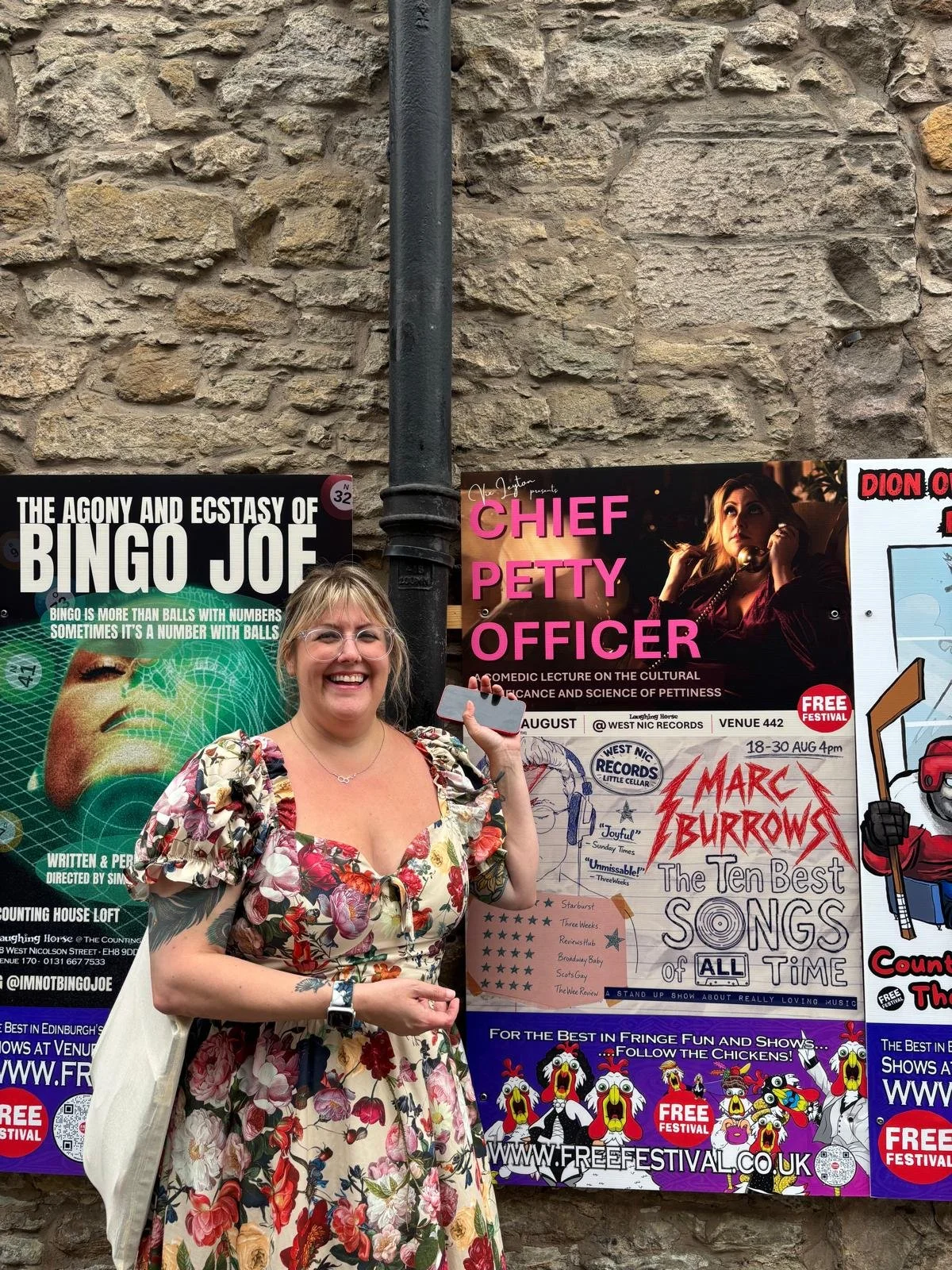
Edinburgh Fringe sell-out Chief Petty Officer comes home to Sheffield
After a sell-out 10-day run at the 2026 Edinburgh Fringe, Chief Petty Officer is coming back to Sheffield for its first performance since the festival.
And, because I believe comedy can happen without destroying your Monday, it’s a civilised Sunday afternoon show, with brilliant support still to be announced. And if you’re just here to find the ticket link, I’m going to make it nice and easy - it’s here! Show is at 4pm on 4th October at Sheffield Plate!
What is Chief Petty Officer?
Chief Petty Officer is my visually driven comedy lecture about pettiness, built from an unreasonable amount of research into the grudges, feuds and magnificently disproportionate acts that have peppered history and popular culture.
What do 50 Cent, Fleetwood Mac, Count Binface, Wagatha Christie and a collection of people who simply could not let something go have in common? Quite a lot, as it turns out.
At the centre of it all is the Hill to Die On, a highly scientific graphical representation of the point at which satisfying pettiness tips over into catastrophic commitment to the bit.
There are strange true stories, original research, history, pop culture, audience judgement and considerably more graph-based analysis than any sensible person would have committed to a stand-up show.
It’s smart, structured nonsense for people who enjoy learning something while they laugh. It’s basically the start of a conversation I hope you continue to have on the tram on the way home, in the pub, at pub quizzes, and via DMs to me when you see petty nonsense out and about after.
From Sheffield to a sell-out Edinburgh Fringe run
Sheffield has been a huge part of this show from the beginning.
I worked on Chief Petty Officer in front of audiences here at The Fat Cat and Square Hole, and I couldn’t have asked for better people to help me figure it out. Sheffield audiences are funny, generous and wonderfully honest. They’ll come with you wholeheartedly when something works, and you also know pretty quickly when it doesn’t. I moved here just over three years ago and there is a real thread of familiarity that matches where I’m actually from, Cardiff. Born Welsh, spiritually Northern by association.
One of the great joys of those shows was what happened afterwards. People would come over and tell me their own petty stories - neighbour disputes, family grudges and tiny acts of revenge they were still visibly delighted with years later. I have learned an enormous amount about this city.
Those performances helped turn a strange idea involving history, pettiness and an ambitious graph into the show I eventually took to Edinburgh.
What I didn’t know was whether there were enough people who wanted an hour of deeply over-researched pettiness to fill a room every day.
There were.
Chief Petty Officer went on to a sell-out the Edinburgh Fringe run, with standing-room-only performances (I stole a chair from another performance one day) and some lovely reviews.
★★★★ - For The Plot Magazine
British Comedy Guide praised the show's “winning graph”, while one of my favourite audience responses described it as feeling “like a recording of a Radio 4 series!”
So it feels particularly special that the first place I get to perform it after Edinburgh is Sheffield. Audiences here were an essential part of making the show, and now I get to bring back the version all that work became.
Who is Chief Petty Officer for?
If you like smart comedy, strange true stories, history, cultural rabbit holes, Radio 4 comedy and watching somebody apply completely unnecessary levels of analysis to relatively minor human behaviour, I think we’ll get along extremely well.
You definitely don’t need to have seen any of the work-in-progress shows, although if you did you’ll probably enjoy seeing what I did next. This is the full post-Edinburgh version of Chief Petty Officer.
Who is Vix Leyton?
Who IS she? In my best Nikki Graham impression. I’m an award-winning comedian, writer, broadcaster and consumer commentator based in Sheffield, with live comedy that has sold out at festivals around the UK.
I’m also the host of The Comedy Arcade, the smash-hit podcast live show, and Sheffield listeners may know me as a regular consumer finance expert on BBC Radio Sheffield. My national broadcast appearances include BBC Morning Live, BBC Radio 4’s You and Yours, LBC and Steph’s Packed Lunch.
Chief Petty Officer brings together a lot of the things I love most - comedy, research, storytelling, history, human behaviour and taking something far more seriously than the situation warrants.
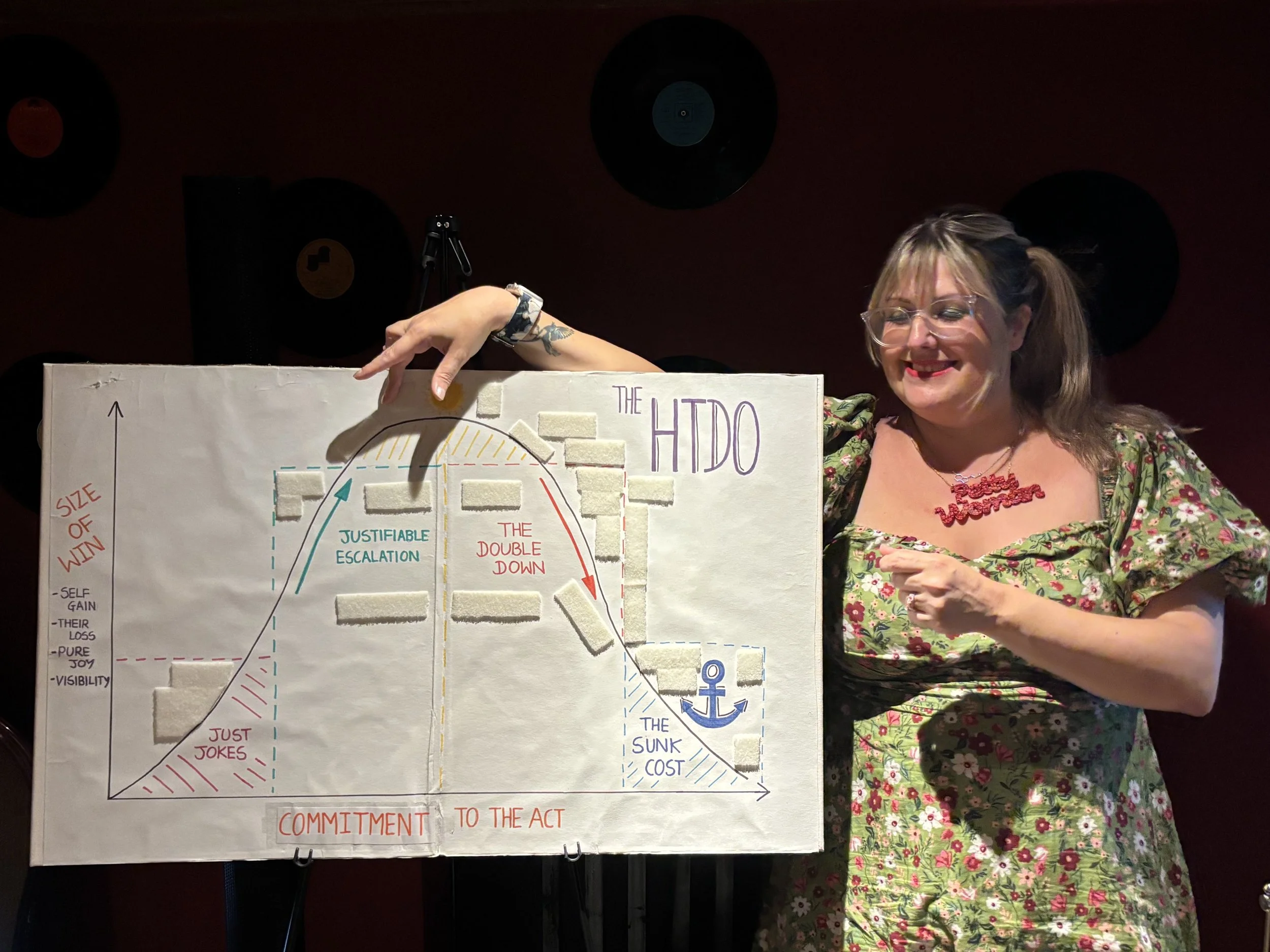
Vix Leyton ends sell out Edinburgh Fringe run with Four-star review
After ten days, a lot of pettiness and considerably more people than there were chairs, Chief Petty Officer has finished its 2026 Edinburgh Fringe run with a four-star review from For The Plot Magazine.
The show, my comedic lecture on the cultural significance of pettiness, ran for ten performances at West Nic Records as part of the Laughing Horse Free Fringe. What started as a slightly nerve-racking experiment in whether people would willingly spend an hour watching me apply unnecessary analytical rigour to grudges, celebrity feuds and historical acts of spite ended with a run of packed rooms and, on the busiest days, standing room only.
For The Plot's Annabel Bruce gave the show ★★★★, describing the combination of storytelling, slides and what she called "completely unnecessary levels of analysis" as giving Chief Petty Officer an identity of its own. The review particularly picked out the show's Hill To Die On Index, which plots petty acts according to the joy they create versus the commitment required to pull them off. This follows a fantastic review from The Scotsman.
The review also praised the mix of familiar stories and more obscure bits of history, as well as the increasingly important question at the heart of the show: when you commit to an act of revenge, who has actually won?
It was a particularly lovely note on which to end a Fringe that exceeded pretty much every expectation I had for it.
Over the course of the run, Chief Petty Officer also appeared in Fringe Biscuit's ranking of the 100 most-talked-about shows online, reaching third place among comedy shows during the festival. Fringe Biscuit's Trends project tracks online conversation and buzz around Edinburgh shows, which made seeing a tiny Laughing Horse Free Fringe show about potholes, Count Binface, 50 Cent and ancient customer complaints sitting alongside much bigger productions feel frankly ridiculous in the best possible way. Just over 300 people were able to catch the show due to the bijou nature of the venue - but they bought bags and took the message to the streets.
There is a peculiar thing about Edinburgh where you spend months building a show, worrying about whether anybody will find it among thousands of alternatives, then suddenly find yourself trying to work out whether another human being can physically fit into the room.
Having people recommend the show, bring friends back, share clips and talk about their favourite petty stories was the bit that meant the most. Chief Petty Officer was always designed to feel less like being lectured at and more like being invited into an extremely over-researched conversation about one of humanity's less noble impulses.
Apparently, quite a lot of people wanted to have that conversation.
Ten shows later, Chief Petty Officer leaves Edinburgh with packed rooms, a four-star review and far more momentum than it arrived with.
Which feels like a pretty good return on several months spent making graphs about revenge. For now, the board goes away but the theory remains. And I still really want to hear about your Hill To Die On picks.
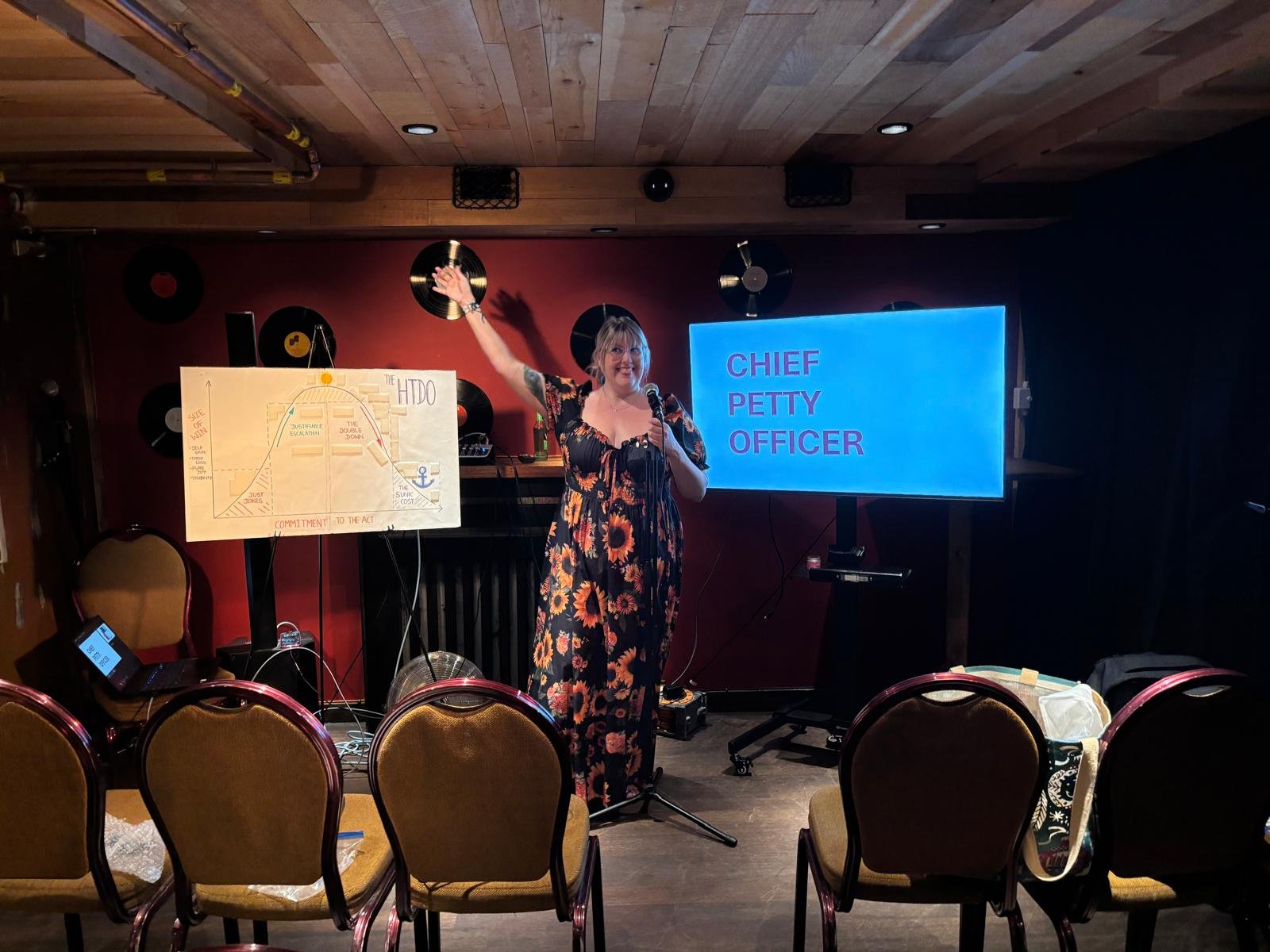
Chief Petty Officer celebrates sold-out opening weekend at Edinburgh Fringe
Vix Leyton’s Chief Petty Officer has had a wonderful start to its Edinburgh Fringe run, with full houses on both Friday and Saturday at West Nic Records and a lovely first wave of reviews from critics and audiences.
It is difficult to describe quite how much that means after spending the best part of a year getting the show here. Chief Petty Officer has travelled through months of work-in-progress performances, rewrites, cuts, additions and the inevitable last-minute tinkering that apparently continues even after you have officially declared something “finished” - if you haven’t seen the version with sound cues and a little dance, you need to come again. Bringing it to Edinburgh was always the big test, so seeing people respond to this odd little comedy lecture about pettiness with such warmth has been a huge and validating joy.
The show asks whether there is a formula for the perfect petty act, using a completely unnecessary amount of research to examine the grudges, revenge plots and moments of minor-minded magnificence that have peppered history and popular culture.
At the centre of it all is the Hill to Die On, a highly scientific graphical representation of the point at which satisfying pettiness tips over into catastrophic commitment to the bit.
The first weekend brought two full houses in the Little Cellar at West Nic Records, including the strange and conflicting Fringe experience of being delighted that the room was full while also feeling genuinely mortified that there were people outside who had wanted to see the show and couldn’t get in. For a Free Fringe show, where you never quite know what the room is going to look like until people start coming through the door, especially one where the only way to get in is to show up and queue - my venue rule, not mine - my Cortisol longs for pre-sales.
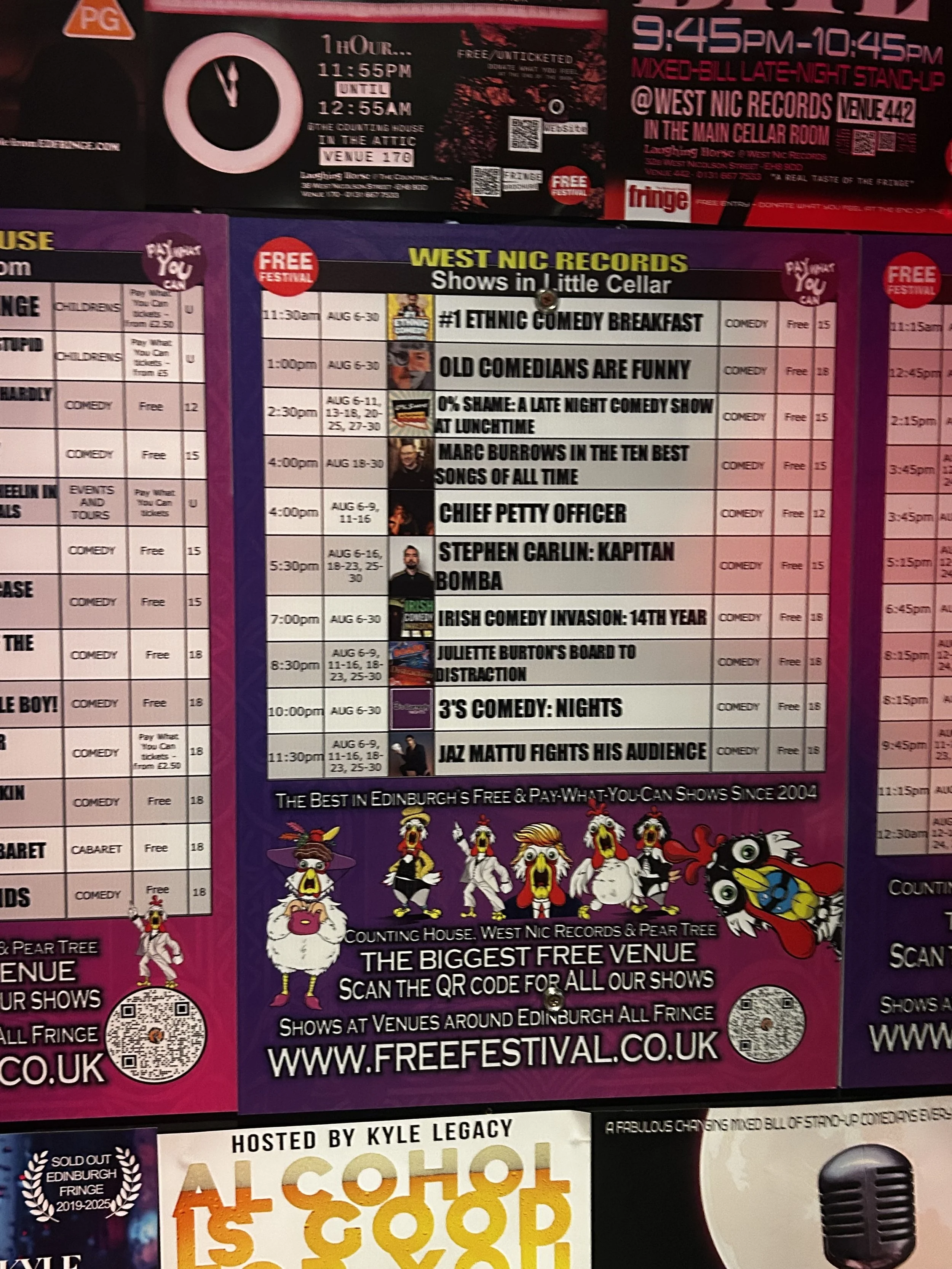
Chief Petty Officer reviews at Edinburgh Fringe 2026
The Scotsman described Chief Petty Officer as “a lovely, friendly way to spend an hour”, praising the show’s journey through “small – and not so small – mindedness across the years”.
Most lovely of all was its response to the enthusiasm at the heart of the show: “When a performer is sharing their genuine fascination with and enjoyment of any subject it makes us enjoy it too. And we do.”
That is probably about as close as anyone could get to describing what I hoped Chief Petty Officer would be. I love these stories, I have spent an unreasonable amount of time disappearing down research rabbit holes looking for them, and the whole point of the hour is to bring an audience with me.
Audience reviews have picked up on that too. Amabel Thornton gave the show five stars, describing it as “a brilliant hour with plenty of well placed laughs” which brings together well-known and lesser-known acts of pettiness before culminating in the story of the perfect petty act.
Alisa, meanwhile, called it “a hilariously technical breakdown” of famous and lesser-known feuds, adding that “Vix clearly relishes the small-mindedness of grudges and brings us right into each story with glee”.
She finished with possibly one of my favourite descriptions of the show so far: “it feels like a recording of a Radio 4 series!” Alisa, thank you for understanding the assignment - I love you.
Ea-Nasir becomes an unlikely Edinburgh Fringe fashion icon
There has also been an unexpected breakout star from Chief Petty Officer, although unfortunately it is a Babylonian copper merchant who has been dead for several thousand years.
Ea-Nasir appears early in the show as the recipient of what is believed to be the oldest surviving written customer complaint. Around 1750 BCE, a spectacularly unhappy customer named Nanni had his grievances about some poor-quality copper committed to a clay tablet, creating a piece of consumer correspondence that has somehow survived for nearly four millennia and, much more importantly, found its way into my comedy show.
For Edinburgh I had a limited number of “DON’T BUY COPPER FROM THIS MAN” tote bags made, mostly because I found the idea extremely funny.
They have subsequently started appearing around the Fringe on the shoulders of audience members, comedians and friends of the show, and have become one of my favourite sights while walking around Edinburgh.
I am not claiming Vogue has declared Ea-Nasir the must-have style item of Edinburgh Fringe 2026, I am simply saying they still have time.
What is Vix Leyton: Chief Petty Officer about?
Chief Petty Officer is a visually driven comedy lecture about pettiness and the surprisingly enormous things human beings will do in service of a relatively small grievance.
The show moves through history, politics, music, celebrity feuds and everyday acts of revenge, looking at what separates an inspired petty act from one that gets completely out of hand. Along the way, everyone from ancient merchants to rap superstars gets put through the same framework in search of the perfect example.
After touring the show in development around the UK, Edinburgh is the first full Fringe run of Chief Petty Officer.
Where can I see Chief Petty Officer at Edinburgh Fringe?
Vix Leyton: Chief Petty Officer continues at West Nic Records - Little Cellar at 4pm from 11-16 August as part of the Laughing Horse Free Festival.
The show is Pay What You Can, with the option to book in advance through the Edinburgh Fringe box office or take a chance on the door.
Mostly, I am enormously grateful to everybody who has already chosen to spend an hour of their Fringe with me. After such a long road getting Chief Petty Officer here, the first few days have been a better start than I could have hoped for.
And if you spot somebody walking around Edinburgh carrying a warning about an ancient Babylonian copper merchant, give them the nod. We’re starting a movement.
The Edinburgh Fringe shows I keep recommending
Every August, people ask me what they should see at the Edinburgh Fringe, which is flattering because it assumes I possess either a complete working knowledge of several thousand shows or that my opinions on comedy are valuable. I can only tell you what I like, and comedy is massively subjective – but with a view to helping you navigate the wilderness even a tiny bit, here are some things I won’t be missing.
Full disclosure - Some are people I have gigged with, some are acts I have followed for years, some are my friends, and one of them is technically my spouse. But I’ve been a comedy fan since I was a teenager – I listened to full show CDs like some people listend to the Backstreet Boys, I have the qualifications to know what’s good objectively.
The Alternative Comedy Memorial Society
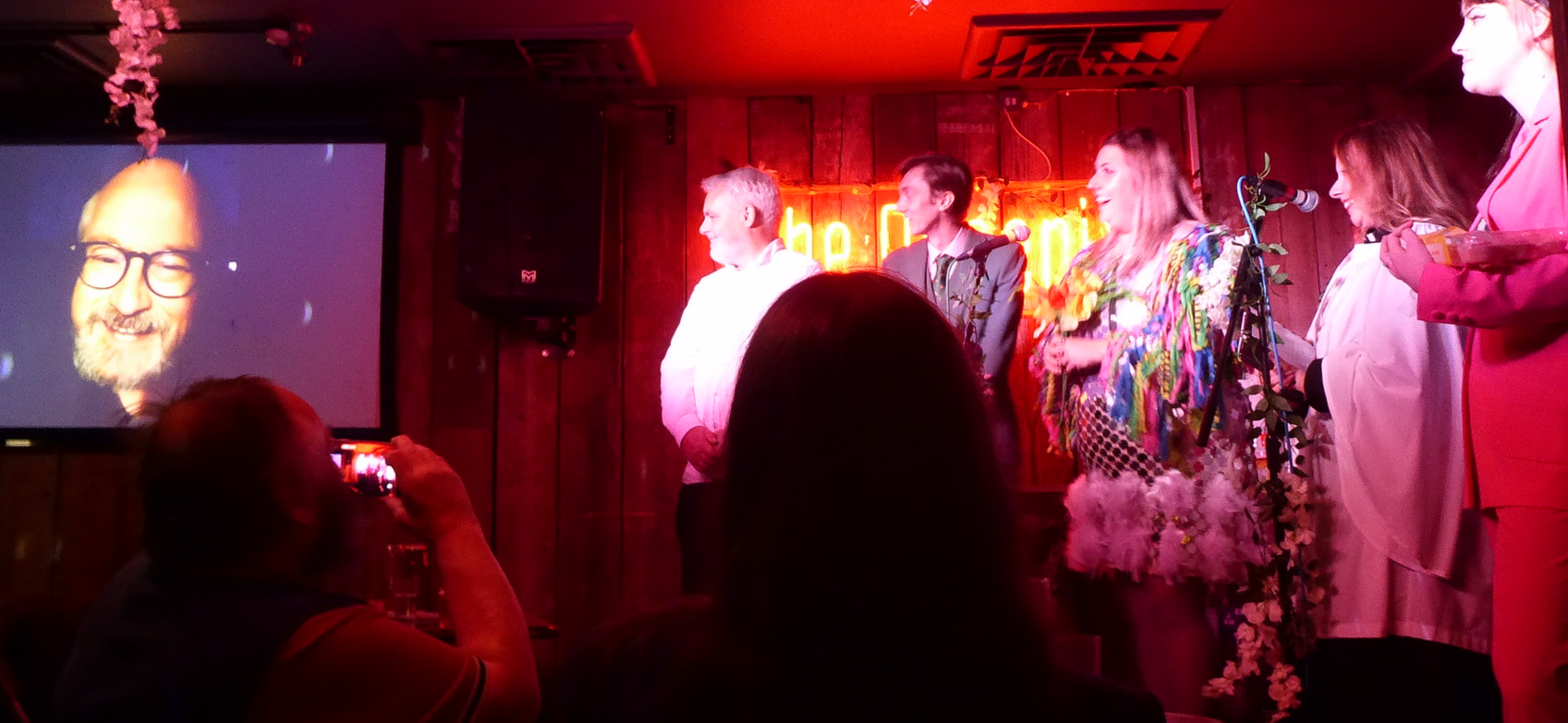
My relationship with the Alternative Comedy Memorial Society began with my first ever stand-up gig and escalated, as these things often do (right?), into marriage.
ACMS began as a regular London night offering comedians a place to attempt work that might be too experimental, impractical or heroically ill-advised for a conventional comedy club. The Edinburgh version is a late-night gathering built around comic experimentation, permitted heckles and the principle of noble failure, with a changing collection of guests attempting things which may never be performed again. This year’s official listing promises more than two hours of “comedic enterprise, dancing and frolicking”, which is more administratively precise than anything I could add.
I did my first gig with ACMS and returned to celebrate my 100th, where I was presented with a commemorative ring. I took this, entirely reasonably, as an engagement request and we subsequently held a wedding, possibly making me the first comedian to marry a comedy night. We’re very happy together.
I go to the Edinburgh shows every year because ACMS embodies the thing I love most about the Fringe; the possibility of seeing an idea before anybody knows whether it works. Sometimes the experiment goes spectacularly wrong, but the room understands that an ambitious failure can be much more entertaining than somebody safely delivering the same seven minutes they have been doing since 2019. At its best, you see the beginning of something that may eventually become a complete show. At its other best, you see something that should never happen again and feel enormously privileged to have seen it the one time it did. Over the years I’ve tried many things, including a dramatic reading of Akon’s Wikipedia page, set to a choir (go and check it out), and being a human jukebox singing songs requested by the audience, whether I knew them or not. It’s liberating, it’s wonderful, it’s like nothing else on earth. Thom Tuck and Isabelle Adam curate something truly special.
HOW TO FRINGE: a chat show with Thom Tuck
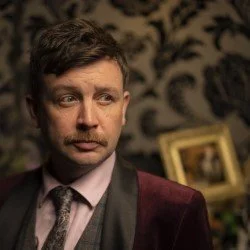
ACMS adjacent, we have Thom Tuck’s new show. The Fringe has a peculiar ability to make you feel you are missing everything, even while you are actively watching something. You can emerge from a brilliant show feeling completely satisfied, only for somebody outside to tell you that a man dressed as a gorilla has just transformed the art form in a room two miles away.
Thom Tuck’s HOW TO FRINGE is a chat show about the festival itself, bringing together guests from different corners of Edinburgh, including comics, producers, actors and reviewers. The official description promises recommendations, gossip and a pot of coffee for the first few people through the door, making it both an entertaining hour and one of the few Fringe shows to acknowledge that audiences may have been awake since yesterday.
I love the premise because the best Fringe recommendations rarely come from a list compiled before the festival has begun. They come from people who have been sitting in small rooms, talking to performers and discovering what is unexpectedly working.
Thom Tuck is a fringe legend – a brilliant comedian and actor, a raconteur and a gorgeous mentor to the newly initiated. He is himself an Edinburgh institution and it’s worth seeing everything he’s in. His every-10-year project, Scaramouche Jones, transported me to the point that I forgot he was Thom Tuck and forgot I was in a yurt for an hour – in an era of second screening and constant stimulation, this is a rare and precious gift.
101 Rules for a Better World (by Comedians)
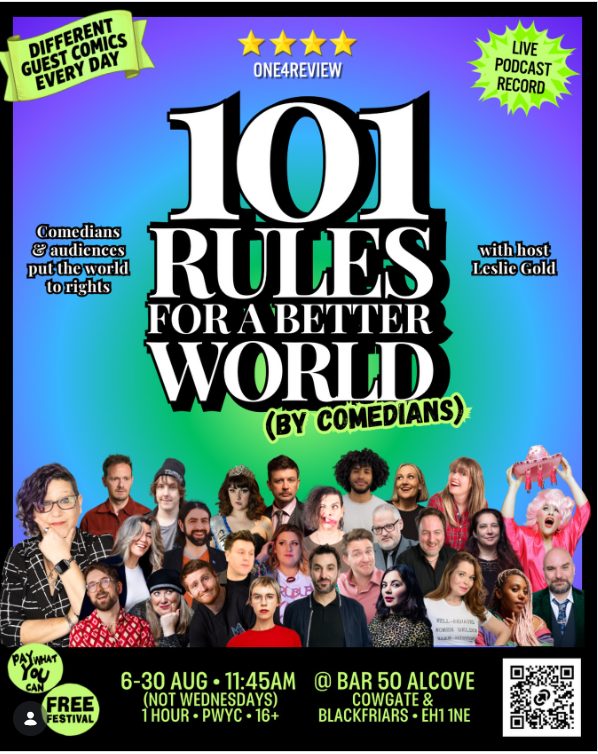
I have a real weakness for panel shows which take a fundamentally ridiculous proposition and administer it seriously, so 101 Rules for a Better World (by Comedians) is very much made for me.
Hosted by the effervescent Leslie Gold with Producer Nick Kirk, the show invites a rotating panel of comedians to propose rules which might improve the world, before the audience votes on whether each one should be adopted. It is now both a live show and a podcast, and previous guests have included Mark Thomas, Bec Hill, Rosie Holt and Alasdair Beckett-King (and me – currently holding a flawless all-laws-passed record, not that I’m showing off. Okay I’m showing off)
The format works so well because almost everybody believes they possess at least one simple idea which would fix society, from major constitutional reform to making people who want cocktails queue separately at the bar. Giving comedians the opportunity to defend those instincts before an audience is exactly the kind of structured chaos I want from a Fringe panel show. You may not leave with a workable blueprint for a better civilisation, but you will almost certainly find yourself continuing the argument afterwards.
Aaagony Aunts
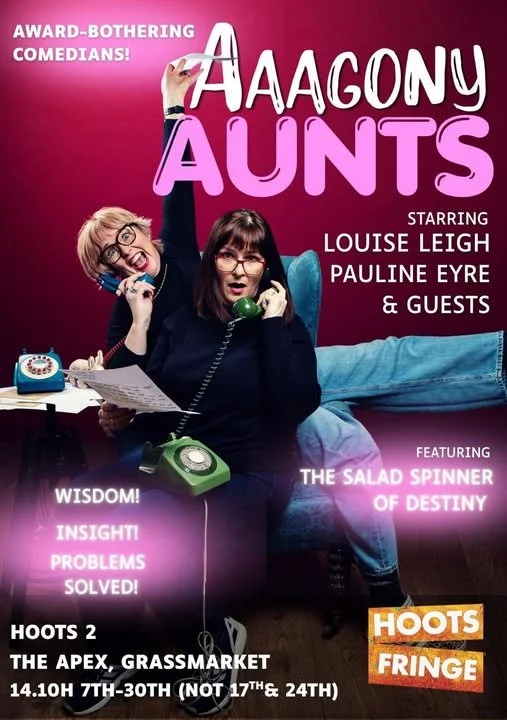
Louise Leigh and Pauline Eyre’s Aaagony Aunts is another excellent example of comedians building a proper format rather than placing four chairs on a stage and hoping chemistry will cover the rest.
The pair invite guest comedians to bring them genuine problems, which are then examined with help from the audience, a selection of kitchen utensils and the Salad Spinner of Destiny. The official promise is to make the world better “one spatula, one messed-up comedian, at a time”, which explains both the ambition and the available resources.
I love the idea of treating comedians as people who should be giving life advice, despite the considerable body of evidence available against that at almost every festival bar, and by virtue of our continued insistence to go to Edinburgh Fringe in the face of ever decreasing returns. More importantly, it creates the possibility of a genuinely different show each day, driven by the particular guest and whatever has gone wrong in their life recently, so you get to see a different side of comedians, even the ones you know well. At the Fringe, that should provide a nearly inexhaustible supply of material.
Marc Burrows in The Ten Best Songs of All Time
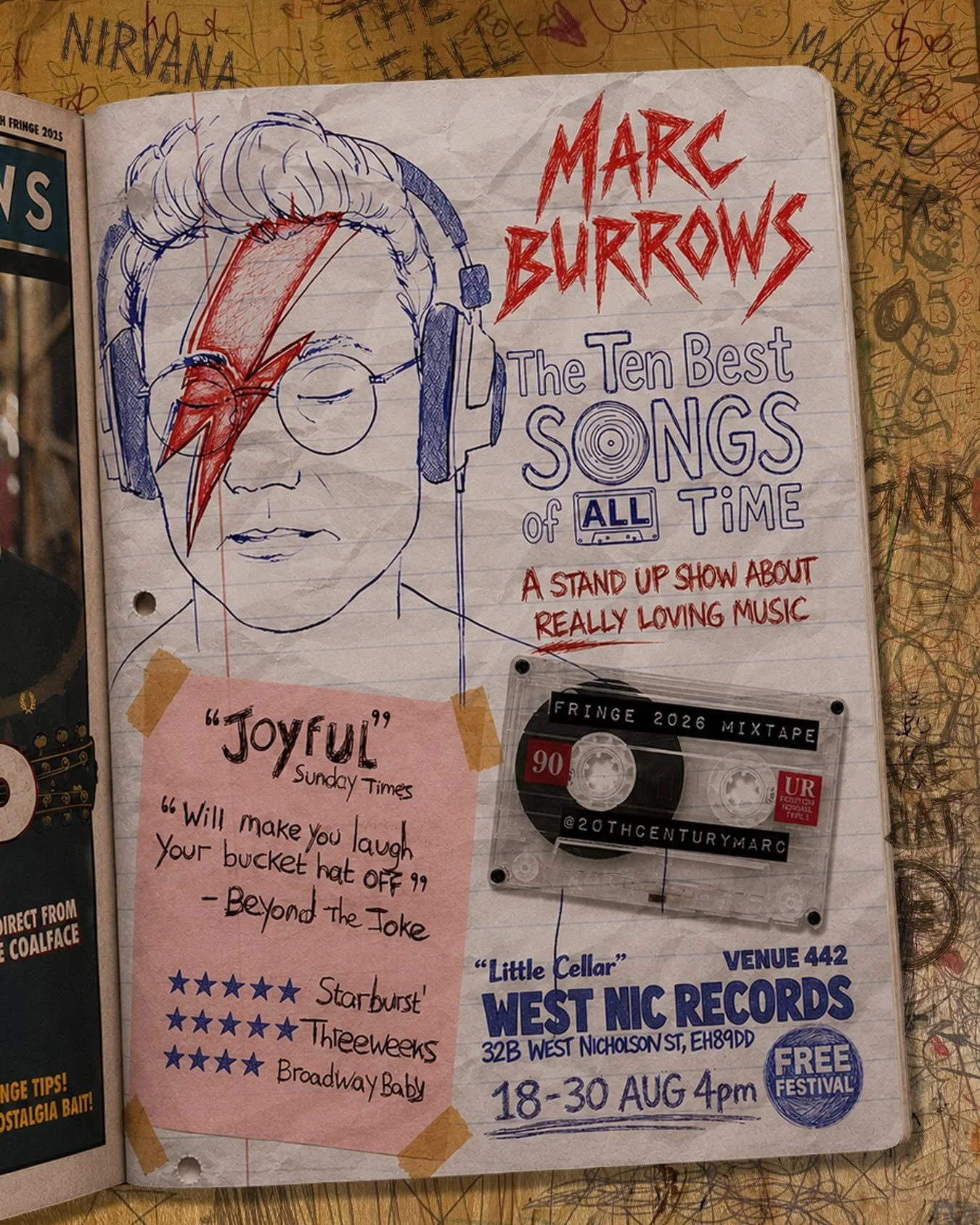
Marc Burrows and I have done several shows together during the run-up to Edinburgh, and he is one of the people I recommend whenever somebody wants clever comedy, that doesn’t require you to work hour. The hour shows flash by in minutes - and in every concept show I’ve seen, you learn something about the subject, the man, and, quite often, yourself. It’s an impressive triple threat.
Marc is one of my best friends now, but the first time we met was at a Work in progress he was doing in Kings Cross in 2017 before I was even doing comedy – I loved his articulate, autobiographical hour, even in its earliest form and over the next near decade he’s got better and better.
His new show, The Ten Best Songs of All Time, sets out to produce an authoritative countdown of the greatest records ever made, while openly conceding that the final selection will almost certainly be subjective and open to argument. This isn’t even the first time he’s done this show, and the list has changed since he last did it. It is described as a show about music, memory and the songs which acquire far more emotional significance than any three-and-a-half-minute recording should reasonably be expected to carry.
Marc is a music journalist and author as well as a comedian, so the research is real, but it never feels like somebody has trapped you inside an unusually lively lecture. His work is warm, accessible and powered by genuine enthusiasm for the subject. It is also an excellent choice for anybody who enjoys leaving a show with both jokes and nostalgia that kicks you back decades and gets you revisiting your playlists for lost gold. Look out for his influence on CPO, it’s most definitely there.
Hannah Platt: Cult Classic
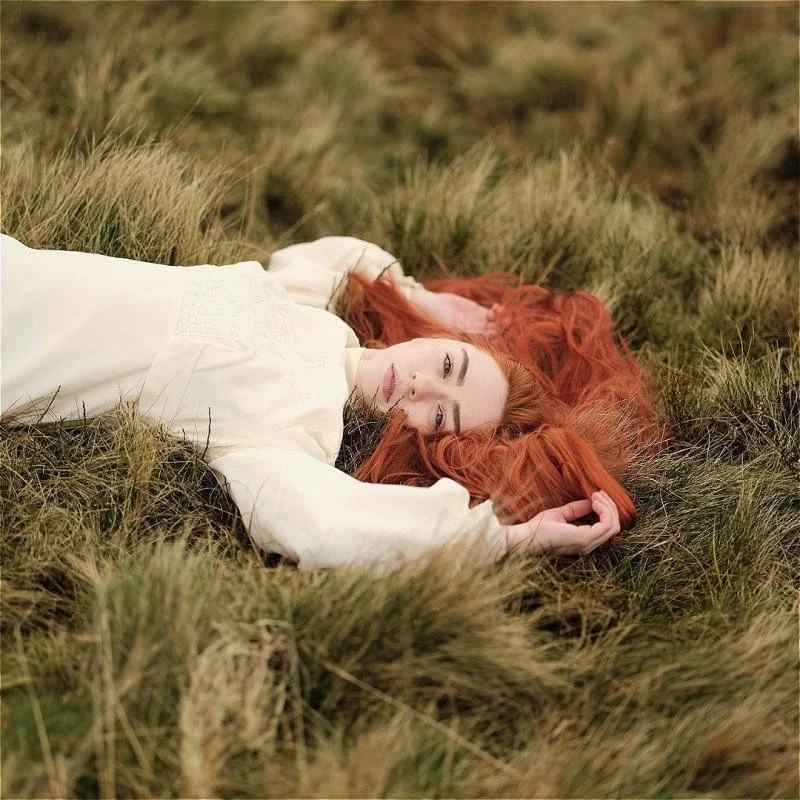
I have been luck enough to have shared work-in-progress bills with Hannah Platt this year and every time I watch her, I enjoy a new element of what she’s been building. Hannah can take difficult, personal material and turn it into comedy without sanding away the parts that made it difficult in the first place, which is a considerably harder task than simply adding a jaunty callback to childhood trauma and hoping nobody notices.
Her new show, Cult Classic, follows her multi-award-nominated debut and uses the language of cults, online belonging and personal sacrifice, what it really takes to start a movement people are willing to die for, and has she maybe already done enough?
Hannah is already moving beyond hidden-gem territory. The point is not that nobody has heard of her, it’s that more people certainly can hear about her as she is exceptionally good and, should you see her now, and still enjoy the brief period before mentioning her starts sounding like you are simply listing famous comedians, rather than genuinely being ahead of the curve.
Andrew O’Neill
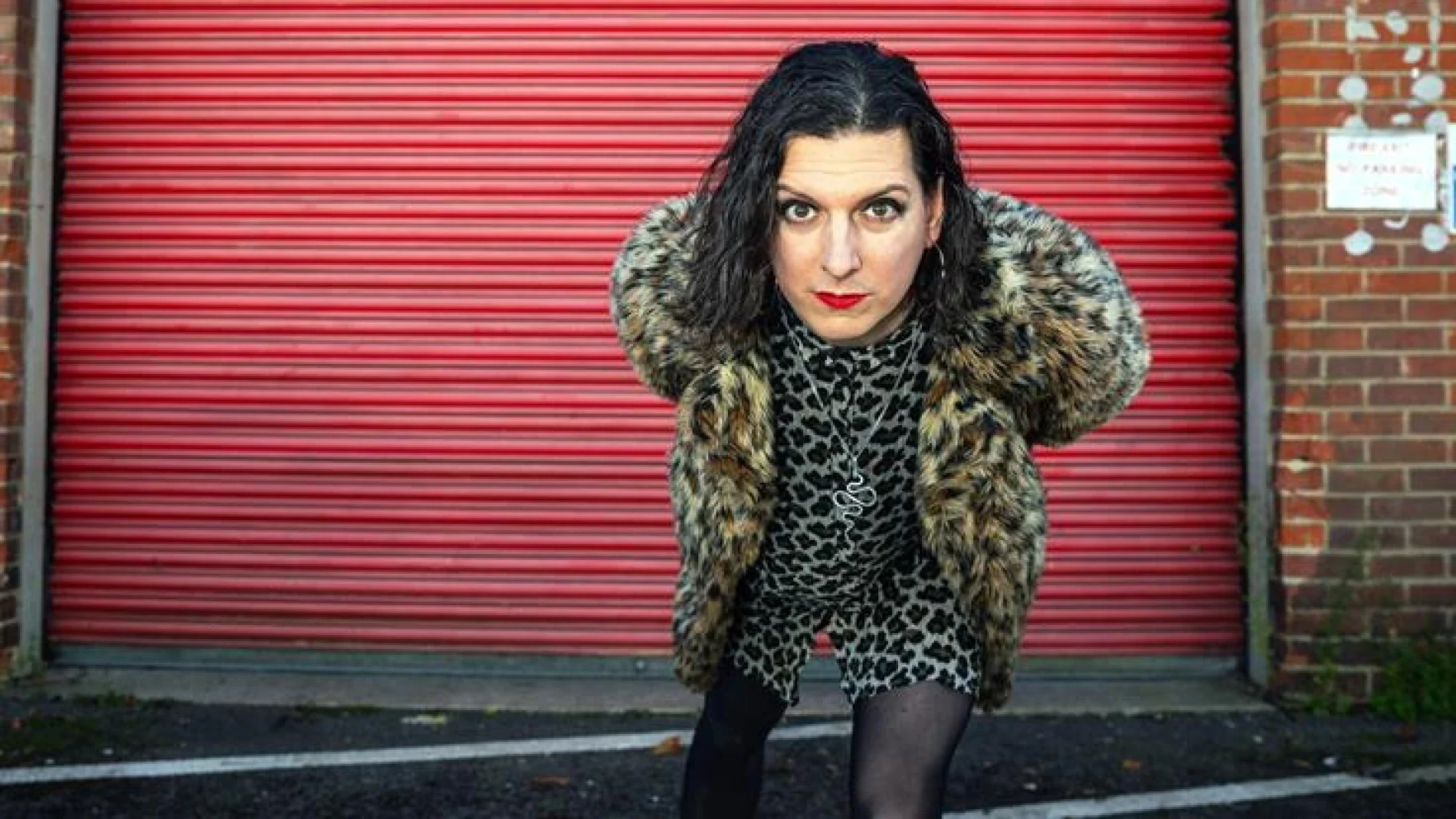
Andrew O’Neill is bringing both A Short, Aggressive Lecture on Krill. Then Jokes and Andrew O’Neill’s History of Punk to Edinburgh, which gives you some indication of the available range before I have attempted to explain any of it. The former is listed as absurdist stand-up, while the latter is a full-volume journey through punk history. They do both with style, grace and perfect execution. I always leave their shows wanting to be better at comedy, and to put the work in to get there.
A lot of Fringe descriptions promise something unique, often immediately after describing a perfectly conventional stand-up show about dating apps. Andrew genuinely delivers work that nobody else would make, which is a distinction worth protecting. I am a huge fan.
Sean Morley: Backchannel
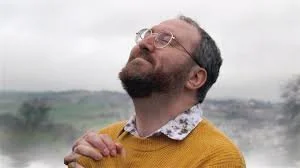
Sean Morley is one of the acts I have been watching for a while, as I’m living in Sheffield and he is a star on the local circuit
His 2026 show, Backchannel, is categorised as multimedia and interactive, although even the official listing eventually admits that his work “defies any sort of description”. That is not a failure of marketing so much as a fairly accurate warning that Sean’s comedy operates according to its own internal technology.
He is surreal, meticulous and able to create the sensation that an entire elaborate system has been built solely to produce a joke which could not have existed by any simpler route. This is exactly the kind of act I go to Edinburgh hoping to find; not merely somebody delivering strong material, but somebody quietly interfering with the accepted idea of what a comedy show is.
Rob Kemp
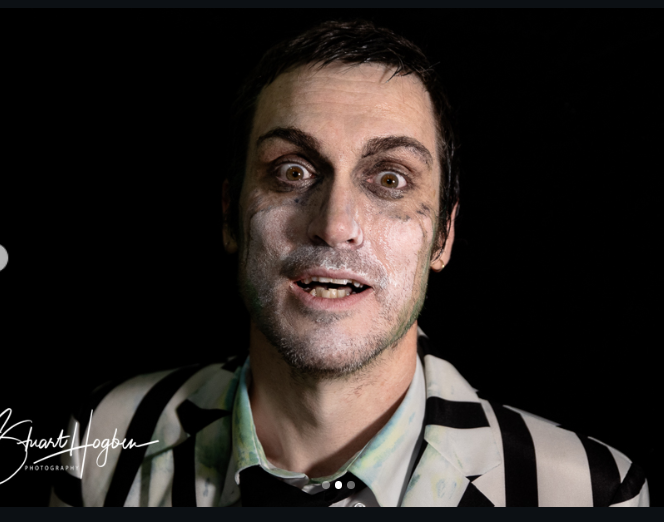
Rob Kemp is best known for The Elvis Dead, his deservedly celebrated retelling of The Evil Dead II through the songs of Elvis Presley. It is one of the great Fringe premises and a show whose reputation has continued long beyond its original run. It’s a riot and I’ll see it whenever I can to remind myself comedy can be anything you want.
I loved his later show, Agenda as much. I saw it at an early work-in-progress stage and even in that early iteration, it had enormous heart, made me laugh and also made me cry; Rob Kemp held the audience in an intimacy that could have felt too much in the wrong hands – but he managed it perfectly.
Beatlesjuice, as the title gives away, is more like the first show than the second but Rob has a proven ability to begin with a title which sounds like somebody has made a joke in a pub, then commit to it with enough imagination and craft to build an entire world. I’ll see anything he does frankly.
Forgotten by Richard Wright
My wildcard this year is not stand-up at all, but Forgotten, a new one-act play written and directed by Richard Wright, the man behind Pegasus Comedy London, one of the nicest new material nights in town with a revolving door of established comics alongside up and comers.
The play is set in a world where creativity meets bureaucracy and asks what happens to stories when they can no longer be told. It is Richard’s first play as a writer and director, which makes it exactly the kind of Fringe gamble I enjoy: somebody known and established for one thing stepping outside the form people know them for to attempt something properly ambitious.
I spend so much of August immersed in comedy that deliberately booking one piece of theatre feels almost like a wellness intervention. I am particularly interested in this because the premise deals with memory, storytelling and what gets preserved, subjects which are not a million miles from my own fascination with the strange ways history selects its heroes and grudges. It is also a fantastic cast list.
Nate Kitch
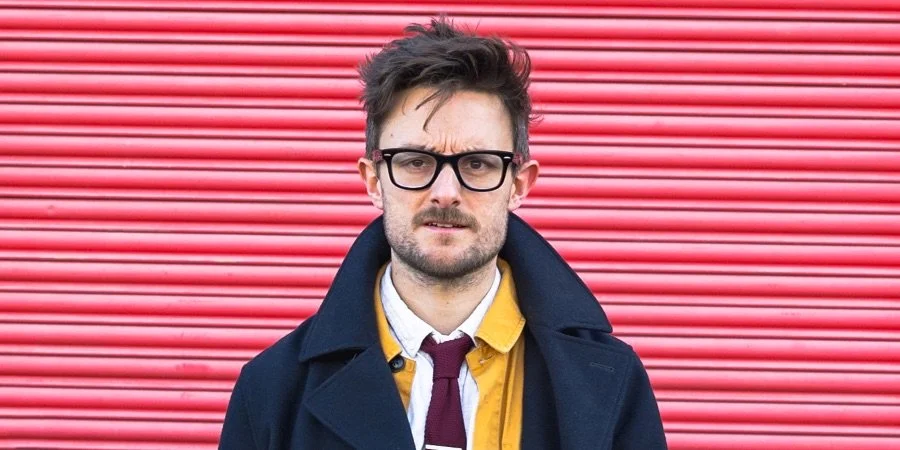
One of the unexpected pleasures of spending so much time on the comedy circuit is spotting people whose brains seem to be wired slightly differently. You don't necessarily know exactly where their career is going to go, but you know it’ll be good.
That's how I felt the first time I saw Nate Kitch.
What I love about his work is that it constantly wrongfoots me. Just when I think I've worked out where a routine is heading, he'll find a completely different route to the punchline, and it's that sense of surprise that keeps me coming back. Comedy doesn't always need to reinvent the wheel, but I do get excited by people who remember it's allowed to.
His show got deservedly great reviews and packed out rooms last year, so don’t sleep on getting tickets for him.
While we're on the subject of people whose brains seem to be wired at an interesting angle, I'd also point you towards Stephen Catling. His show is gloriously surreal in exactly the way the Fringe should be - the sort of hour where you stop trying to predict what's coming next and simply enjoy the ride. If your Edinburgh usually consists of back-to-back stand-up, I'd really encourage you to throw one or two shows like Stephen's into the mix. They're often the ones you remember longest.
It also gives me an excuse to mention what Hoots are building in their stable of venue. Their new Nicolson Square hub has been designed very deliberately around artists who want to do something a bit different, expanding on the alternative ethos they developed at Potterrow with six performance spaces, including the geodome, and a programme that leans towards inventive, left-field work rather than simply chasing the biggest names. They're refreshingly open about wanting to create an artist-driven Fringe that's both more affordable and more rewarding for performers, and I really hope audiences reward that by taking a chance on something they might not otherwise have booked.
Anything by Queer Comedy Club
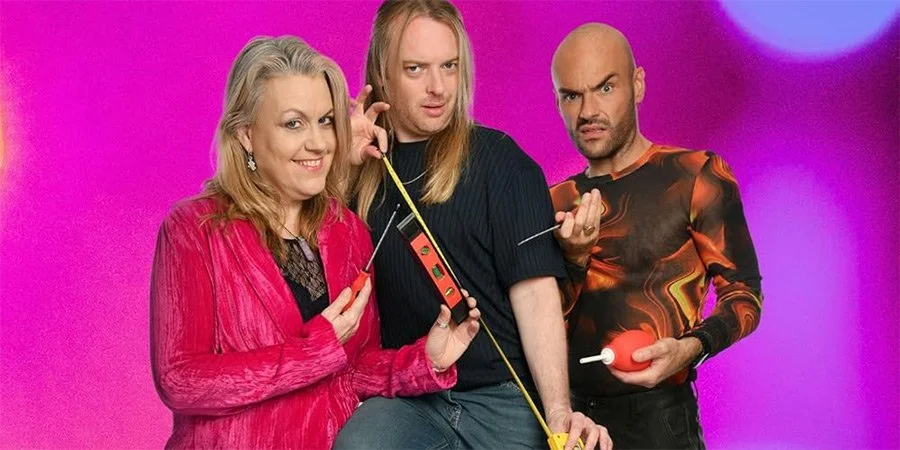
I’d also make time for the Queer Comedy Club’s shows at Gilded Balloon, because they always manage to combine properly high production values and a huge amount of fun with a genuine platform for queer performers at every stage, from newer acts finding their feet to major international names. Best of the Queer Fringe has a different mixed bill every night and has previously welcomed comics including Caroline Rhea, Sarah Keyworth, Reuben Kaye and Jessica Fostekew, so it is fantastic value if you want to discover several acts in one go. Their other 2026 show, Married at Fringe Sight, is an interactive crowd-work format where the hosts create three couples from the audience, everyone votes for their favourite and the winners are married before the hour is over, which feels like an admirably efficient response to the modern dating crisis.
In previous years they have also taken Gag Race, an audience-scored stand-up competition, to Edinburgh, which gives you a sense of how much thought they put into creating actual formats rather than simply assembling another bill. The whole operation feels welcoming, inclusive and joyfully ambitious, while giving a remarkable number of queer acts access to a bigger stage. Some big names had breaks with them in their London club and owe a lot of their polish to the practice time they were given (as well as smaller names, like me)
David Ian, Kate Dale and Jeremy Topp also get a best supporting comedian award for the community they create around the events as well. They’re some of the kindest, coolest people and if you get the chance to go for a drink with their glorious gaggle, go for it. They are the best night out in town.
Sarah Hester Ross – Serving C*nt
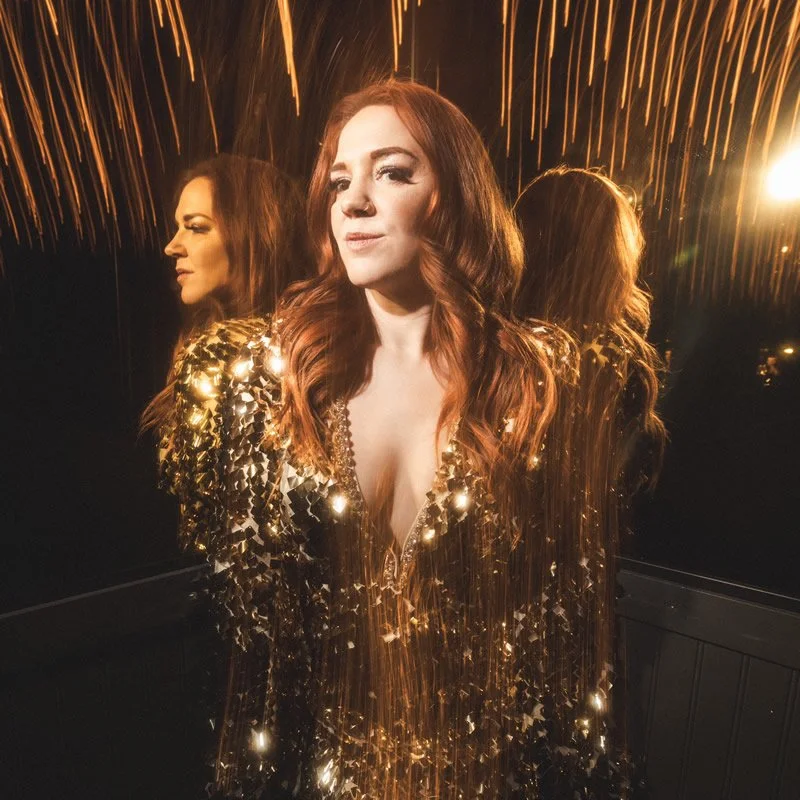
Talking of polish, Sarah Hester Ross is a genuine US superstar and an extraordinary live performer, combining huge cabaret vocals, razor-sharp musical comedy and the sort of fearless stage presence that makes a room feel slightly more exciting the moment she walks into it. Her new show, Serving C*nt, is part concert, part confessional and completely riotous, bringing together the viral songs that have earned her millions of followers with material about women’s rights, bodily autonomy and the general consequences of continuing to hand microphones to the wrong men. The moment I met Sarah, I immediately understood why she has built such a huge audience in the US. She is a phenomenal musician as well as a brilliant comedian, and this feels like a rare chance to catch somebody with proper international-star energy. Plus her wardrobe is to die for. When I think my outfit might be ‘too much’ , I remember Sarah and add another element - an inspiration.
Sam See’s Off With Your Head

I absolutely love a comedy format, and Sam See's Off With Their Heads is exactly the sort of show I always end up evangelising about. It's essentially a tabletop game brought to life, with comedians taking on the role of rulers of a fictional universe and making increasingly questionable decisions with the audience helping to shape the fate of their civilisation. Every show is different, it's gloriously chaotic, and it's a brilliant reminder that comedy doesn't have to be somebody standing behind a microphone for an hour. You never know what’s going to happen. I was once in the audience for a show where Sam led a daring raid into John Robertson’s show in another building, replicating a Twitch raid in real life.
The Fringe is at its best when people are inventing new ways to make audiences laugh, and Off With Their Heads feels like exactly that. Sam See is an absolute powerhouse in terms of charisma and work ethic, so is worth checking out across the board but I have a lot of love for this specific show. And a show with a history element? Definitely need more of those…
Best in Class
One final recommendation is not for a single performer but for Best in Class, the compilation show created by Sian Davies, one of the hardest working people in comedy, built to give working-class comedians a route into a festival where the costs can make participation feel less like an artistic opportunity and more like an elaborate financial threat.
Compilation shows are always useful when you want to discover several acts in one slot, but this one also serves a larger purpose by creating a platform for voices which can be squeezed out before audiences ever get the chance to hear them. It is a strong way to begin a Fringe trip because you may leave with several entirely new names to follow, rather than relying on an algorithm which has understandably decided that the safest recommendation for everybody is James Acaster. They have a fantastic hit rate for acts going on to bigger stages so you’ll also get the ‘I saw them first’ credit as well as the warm glow of contributing to the dangerously diminishing flow of Working Class voices cutting through.
How to choose what to see at the Edinburgh Fringe
I am not going to tell you to abandon all planning, because accommodation already costs enough without adding the emotional expense of discovering your must-see show sold out yesterday. Book the things you would be genuinely upset to miss, then leave enough space for recommendations, accidents and whatever piece of paper somebody presses into your hand while you are trying to cross the Royal Mile.
See the known quantities you love, but take at least one proper risk. Go to a panel show, an experimental late-night event, a work in progress or a new play by somebody trying a different form. Listen when comedians recommend other comedians, because we spend an alarming amount of time watching one another and are generally very excited when somebody is doing something good.
Most importantly, do not turn the Fringe into an exercise in optimisation, as you will miss brilliant things if you don’t take the time to look up. The aim is not to construct the objectively perfect schedule but to come home with one or two shows you cannot stop talking about, ideally including at least one you only saw because somebody you trust became unreasonably evangelical about it.
Edinburgh has a habit of making fools of anyone who tries to produce a definitive list (approach the ones in the National press with a smidge of cynicism and an awareness of how much it costs to get a PR for Fringe and what that means for these lists). I'll publish this, immediately remember half a dozen people I've accidentally left out, then spend the rest of August recommending completely different shows to the ones above because somebody caught me in the Pleasance Courtyard at the wrong moment.
I've deliberately skipped over some of the obvious recommendations like Fringe legend Mark Watson, because I suspect you've already got them on your list, and this was never meant to be a league table – it’s simply a slightly chaotic snapshot of the people and shows I've found myself talking about recently, whether that's because they made me laugh, made me think, did something I've never seen before or just reminded me why I love spending every August in Edinburgh.
If you do end up seeing any of them, I hope you have as good a time as I did. And if you discover somebody brilliant who isn't on this list, come and tell me afterwards. I'm always looking for my next recommendation.
And don’t forget to see my show if you can. Did I mention I’m doing a show? It’s called Chief Petty Officer. xoxo
Not going to Edinburgh Fringe?
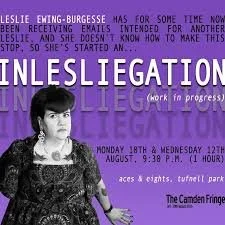
Don’t overlook Camden Fringe. Some of my favourite discoveries have happened there, and it's become a brilliant place to catch ambitious new work without the chaos of August in Scotland.
If you're looking for somewhere to start, I'd heartily recommend Leslie Ewing Burgesse's Inlesligation. Leslie has a wonderfully distinctive comic voice and an instinct for ideas that are just the right side of gloriously ridiculous, her latest show - an investigation into a woman inadvertently sharing her email address, is one of her best yet already, and still in work in progress stage.
Camden Fringe is exactly the sort of festival where shows like that get to flourish, so if you're craving that feeling of discovering something before everyone else starts talking about it, it's well worth a look. Leslie curates a fantastic programme at Aces & Eights, and oversees a fantastic space for trying new ideas - expect hidden gems and big names.
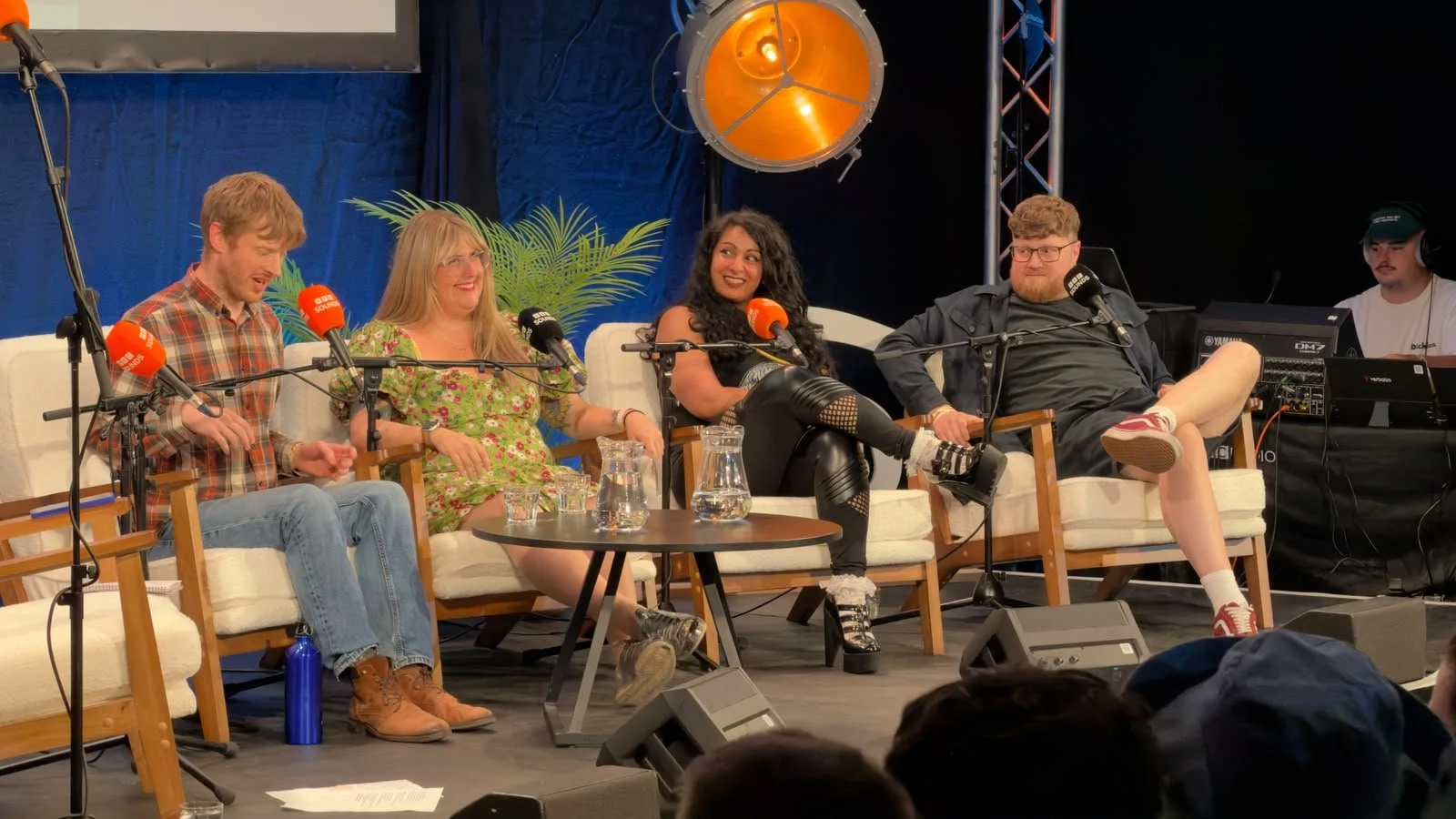
Vix Leyton joins Nicky Campbell for Don’t Say A Word live special at Sheffield’s Crossed Wires Festival
Sheffield-based comedian and broadcaster Vix Leyton joined Nicky Campbell for a special live recording of his BBC Sounds podcast Don’t Say A Word at the Crossed Wires Festival.
Recorded in front of an audience of several hundred people at Sheffield’s former Cole Brothers department store, the season finale brought together Leyton, Seeta Wrightson, David Eagle and Pete Selwood for a wide-ranging conversation about stand-up comedy, changing language and where performers draw the line when writing jokes.
For Leyton, being invited onto the panel was particularly meaningful because Sheffield is not simply where the festival happened. It is home.
“Crossed Wires is such a brilliant thing for Sheffield, so being asked to take part meant a lot,” says Leyton. “There was something properly special about walking into that huge room in the middle of the city, seeing a few hundred people waiting for a live podcast recording, and getting to be part of the conversation rather than sitting in the audience.”
What was the Don’t Say A Word Crossed Wires episode about?
Hosted by broadcaster Nicky Campbell, the live episode explored how stand-up comedians decide what belongs in a routine, what feels off limits and who gets to make that decision.
The conversation looked at the way language, social expectations and public reactions continue to change, alongside the particular responsibility comedians face when making jokes about experiences outside their own.
Leyton appeared alongside comedians Seeta Wrightson, David Eagle and Pete Selwood, each bringing a different perspective to a discussion that covered race, disability, sexuality, identity and the way personal experience shapes what a performer feels able to say on stage.
It was a subject well suited to a live comedy panel because there are no especially neat answers. Stand-up depends on surprise, tension and pushing at boundaries, but those boundaries are neither fixed nor shared equally by everyone in the room.
The result was less a debate about whether comedians should be “allowed” to say particular things and more an examination of judgement: how performers read an audience, how context changes a joke and what happens when the intent behind a line bears little resemblance to the impact it has.
Who appeared on the live panel?
Nicky Campbell was joined by three stand-up comedians alongside Vix.
Seeta Wrightson, a comedian, podcaster and writer
David Eagle, a comedian and musician
Pete Selwood, a stand-up comedian and podcaster
The panel gave each performer space to discuss how their own identity and lived experience informed the material they wrote, as well as how they approached subjects associated with communities to which they did not belong.
Campbell also brought music into the live recording, performing original songs tackling subjects that can be difficult or uncomfortable to discuss directly. The combination of panel conversation, live comedy and music made the special feel distinct from a conventional studio podcast episode.
Why appearing at Crossed Wires mattered to Vix Leyton
Although Leyton is originally from Wales, she now lives in Sheffield and has developed much of her recent comedy work in the city.
That made appearing at Crossed Wires feel less like travelling in for another media booking and more like being invited to contribute to something happening in her own community.
“Sheffield has become home, and it is exciting to see something of this size happening here,” she says. “So many major cultural events still feel as though they automatically belong in London. Crossed Wires bringing broadcasters, comedians, podcast makers and audiences into the centre of Sheffield feels important, and I was genuinely proud to be included. It doesn’t hurt that I am a huge fan of the show so surreal to be inside it. If you can’t explore the expression of pronouns through the medium of sea shanty, what are you doing with your life?”
The recording took place in the former Cole Brothers building, a familiar Sheffield landmark transformed into a large temporary performance space for the festival. Despite the scale of the room and the audience, the panel format allowed the discussion to remain conversational, with the live crowd becoming part of the energy of the episode.
What is Nicky Campbell’s Don’t Say A Word podcast?
Don’t Say A Word is a BBC Sounds podcast hosted by journalist and broadcaster Nicky Campbell.
The series examines changing language, cultural expectations and the increasingly complicated question of what people can say, watch, read or laugh at, as well as who gets to decide where those boundaries sit.
Rather than treating language as a fixed list of acceptable and unacceptable words, the podcast looks at context, intention, identity and the speed with which social norms evolve.
The Crossed Wires season finale moved the conversation specifically into the world of stand-up comedy, where performers are expected to take risks but are also immediately accountable to a live audience.
Vix Leyton on comedy, identity and changing language
The subject of the episode connects closely with Leyton’s own experience as a queer Welsh comedian whose stand-up often draws on identity, class, journalism and the absurdities of public life.
It also arrived while she was preparing to take her second solo show, Chief Petty Officer, to the Edinburgh Festival Fringe.
The show examines famous grudges and acts of pettiness from history and popular culture, but its development has involved many of the same questions discussed by the panel: who owns a story, how much context an audience needs and where the line sits between analysing someone’s behaviour and simply making them the target.
For Leyton, conversations about the boundaries of comedy are most useful when they move beyond the idea of a single line that everybody must either defend or obey.
“Comedy would be much easier if there were one clear boundary and somebody had helpfully marked it with tape but there are simply too many variables” she says. “In reality, you are constantly making decisions about the story, the audience, your intention and whether the joke earns the right to go where it is going. That does not mean never taking a risk. It means understanding what the risk actually is.”
Listen to Vix Leyton on Don’t Say A Word
The Crossed Wires live special is the season finale of Nicky Campbell’s Don’t Say A Word and is available through BBC Sounds.
The episode features Nicky Campbell in conversation with Vix Leyton, Seeta Wrightson, David Eagle and Pete Selwood, exploring stand-up comedy, identity, changing language and how performers navigate the boundaries of what can be joked about.
Listen to the episode on BBC Sounds:
Here
Listeners can also find the full series through the Don’t Say A Word page on BBC Sounds, Apple Podcasts and Spotify.
What is Crossed Wires Festival?
Crossed Wires is a major podcast festival held in Sheffield, bringing together broadcasters, comedians, journalists and podcast creators for live recordings, performances, interviews and audience events.
The 2026 festival took place across the city from 2 to 5 July, with the Don’t Say A Word special recorded on 3 July at the former Cole Brothers building.
For Leyton, its success is also a reminder of the importance of large cultural events being created outside London.
“There is a huge audience for this in the North, and Sheffield is such a natural home for something curious, welcoming and slightly unconventional,” she says. “I hope Crossed Wires continues to grow, because the city absolutely showed up for it.”
About Vix Leyton
Vix Leyton is a Welsh stand-up comedian, broadcaster, writer and consumer finance commentator based in Sheffield.
She appeared as a guest on the live season finale of Nicky Campbell’s Don’t Say A Word at the 2026 Crossed Wires Festival, alongside Seeta Wrightson, David Eagle and Pete Selwood.
Her second solo show, Chief Petty Officer, is a visually driven comedy lecture examining history’s greatest acts of pettiness, from public feuds and sporting meltdowns to ancient complaints and spectacular campaigns of revenge.
Following a 16 date UK work-in-progress tour, Chief Petty Officer runs at the Edinburgh Festival Fringe from 6 to 16 August 2026 as part of the Laughing Horse Free Festival at West Nic Records.
Vix Leyton cast in comedy murder mystery podcast Murder of a Famous Bastard
Welsh comedian and broadcaster Vix Leyton appears in several episodes of Murder of a Famous Bastard, the comedy murder mystery podcast created by Mark Watson.
Leyton plays Leah Vicks, a Welsh gossip columnist drawn into a sprawling investigation involving a murdered television personality, a large cast of suspects and a private detective who has the added inconvenience of being under suspicion himself.
The role was written with Leyton in mind by Watson, who was also one of the first established comedians to encourage her when she began performing stand-up.
“Mark was the person who first spotted me as a comedian, so it was a lovely surprise to hear that he had written a character for me,” says Leyton.
“There is something very full circle about getting to work with someone who encouraged you early on, particularly on a project this ambitious. I was a massive fan of the show before I was in it - and my biggest worry is I would ruin it for myself because it’s so extraordinarily cringeworthy hearing your own voice. Thankfully the writing was so good, I got through it.”
What is Murder of a Famous Bastard?
Written by and starring Mark Watson, Murder of a Famous Bastard is an episodic comedy murder mystery following private detective Hugh Flounder.
Hugh is invited to the 60th birthday party of famous television personality Stevie Chase, but by the following morning someone is dead.
The case could be the opportunity Hugh has been waiting for, were it not for the fact that attending the party also places him among the suspects.
As the investigation unfolds, listeners meet a large ensemble of guests, witnesses and possible culprits, each with their own version of events and varying reasons for wanting the truth to remain unclear with an all star cast including Shapark Khorsandi, Rosie Holt, Alastair Beckett-King, Lulu Popplewell, Rufus Hound and Alex Horne.
The series combines a traditional whodunnit with character comedy and invites listeners to follow the clues, develop their own theories and attempt to solve the murder alongside Hugh.
Who is Leah Vicks?
Leah Vicks is a Welsh gossip columnist played by Vix Leyton.
Her work depends on knowing what public figures would rather keep private, making her a useful presence in a story built around secrets, reputations and competing accounts of what happened.
The character was created specifically for Leyton, drawing on her Welsh background and comic voice. She is, herself, from Cardiff and deeply regrets making the decision to do the whole thing in a Swansea accent.
Leyton is best known for stand-up, broadcasting and her work as a consumer finance commentator, where asking awkward questions and looking beyond the official version of events are already part of the job.
Her appearance in Murder of a Famous Bastard marks a move into scripted audio comedy alongside her live and broadcast work.
Watson was among the first established comedians to support Leyton when she began performing stand-up, making the podcast collaboration a particularly meaningful one.
Rather than casting her in an existing part, he wrote Leah Vicks with Leyton in mind.
For Leyton, the appeal was not only the chance to work with Watson, but to join a project that gives its characters and mystery room to develop across multiple episodes.
“It is a very generous thing to have someone write with your voice in mind,” she says.
“I also loved the scale of it. There are so many characters, motives and possible directions that you become just as interested in solving the mystery as the listeners are, with the extra element of not having anything beyond your lines so you could be the murderer yourself and not even know”
How to listen to Murder of a Famous Bastard
Murder of a Famous Bastard is available through major podcast platforms, including Apple Podcasts and Spotify.
The series is best heard from the opening episode, as the clues, relationships and suspicions build throughout the investigation.
Listeners can follow Hugh Flounder’s attempts to solve the murder while deciding which members of the cast are reliable, which are hiding something and who may have had a reason to kill him.
Who is Vix Leyton?
Vix Leyton is a Welsh stand-up comedian, broadcaster, writer and consumer finance commentator.
She appears as Leah Vicks in Murder of a Famous Bastard and is the creator of Chief Petty Officer, a comedy lecture examining history’s greatest grudges, revenge campaigns and acts of spectacular score-settling.
Following a UK work-in-progress tour, Chief Petty Officer will run at the Edinburgh Festival Fringe from 6 to 16 August 2026 as part of the Laughing Horse Free Festival at West Nic Records.
Frequently asked questions
Is Vix Leyton in Murder of a Famous Bastard?
Yes. Vix Leyton plays Leah Vicks, a Welsh gossip columnist, in Mark Watson’s comedy murder mystery podcast.
Did Mark Watson write Leah Vicks for Vix Leyton?
Yes. Watson wrote the character with Leyton in mind, having first supported her when she began performing stand-up comedy.
What is Murder of a Famous Bastard about?
The podcast follows private detective Hugh Flounder as he investigates the murder of television personality Stevie Chase, despite being one of the suspects himself.
Where can I listen to Murder of a Famous Bastard?
The series is available on Apple Podcasts, Spotify and other major podcast platforms.
Is Murder of a Famous Bastard a comedy?
Yes. It combines a murder mystery with character comedy, an ensemble cast and an ongoing investigation that listeners can try to solve themselves, and there is a vibrant discord community.
Britain’s pettiest moments revealed: M&S versus Aldi’s caterpillar cake feud takes the crown
A survey of 2,000 UK adults has named the M&S and Aldi caterpillar cake battle as Britain’s greatest petty pop culture moment, while one in five people admits to being petty themselves.
Britain may pride itself on stiff upper lips and good manners, but new research suggests we are also a nation of people quietly keeping score.
A survey of 2,000 UK adults found that 21% openly describe themselves as petty. Among people aged 18 to 29, that rises to 38%.
The research was commissioned by stand-up comedian and broadcaster Vix Leyton for Chief Petty Officer, her comedy lecture exploring history’s greatest grudges, acts of revenge and spectacular overreactions.
Participants were also asked to choose the greatest petty moments in recent British pop culture. From caterpillar-shaped cakes and celebrity court cases to protest votes and Christmas chart campaigns, the results reveal the grudges, rebellions and beautifully unnecessary escalations that have captured the country’s imagination.
What is Britain’s pettiest pop culture moment?
The legal battle between M&S and Aldi over their rival caterpillar cakes was named Britain’s greatest recent petty moment, selected by 32% of respondents.
It finished ahead of the Wagatha Christie trial, chosen by 26%, and Meghan and Harry’s interview with Oprah Winfrey, selected by 21%.
Britain’s top 10 petty pop culture moments
M&S versus Aldi’s caterpillar cakes - 32%
The Wagatha Christie trial - 26%
Meghan and Harry’s Oprah interview - 21%
Boaty McBoatface - 15%
“What a sad little life, Jane” from Come Dine With Me - 14%
Sam Smith’s pub smart-device ban - 12%
The Rage Against the Machine Christmas number one campaign - 11%
Wetherspoons’ Brexit drinks decision - 11%
Lorraine Kelly versus the attendance tracker - 10%
Other acts of nationally significant score-settling - proving Britain is not short of candidates
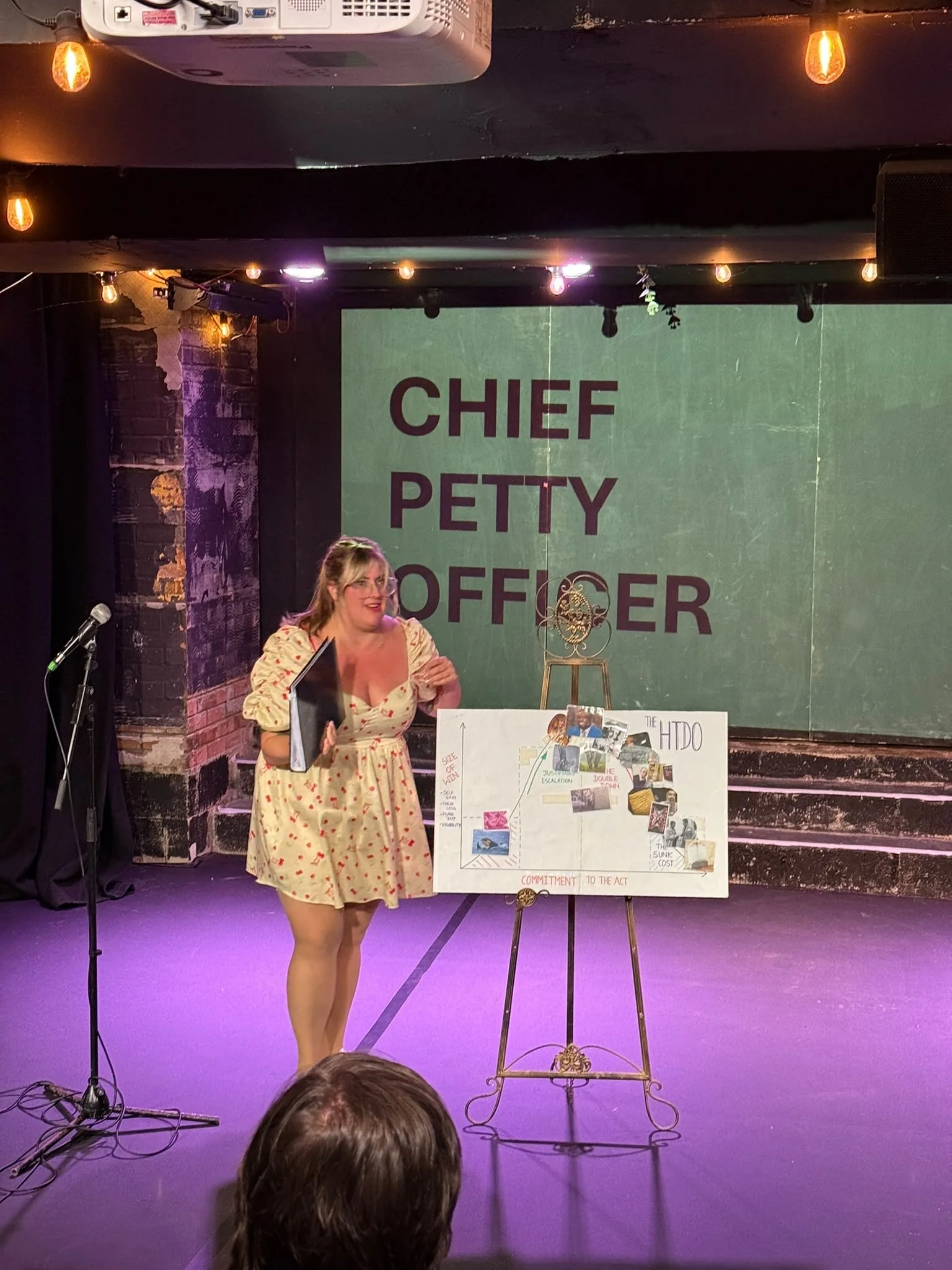
The caterpillar cake dispute began after M&S took legal action over similarities between its Colin the Caterpillar cake and Aldi’s Cuthbert the Caterpillar.
What followed was not simply a disagreement about chocolate sponge. It became a national spectacle, fuelled by social media posts, brand jokes and an audience increasingly invested in the fate of two supermarket caterpillars.
For Leyton, it is a near-perfect example of a small grievance becoming culturally enormous once other people are invited to watch.
Why was M&S versus Aldi considered so petty?
In Chief Petty Officer, Leyton assesses grievances using the Hill To Die On scale, a comic framework designed to answer one central question: was the satisfaction gained from escalating the dispute worth the cost?
The M&S and Aldi feud scores highly because the original issue was comparatively small, but the escalation was public, prolonged and enormously entertaining to everyone outside it.
It also illustrates one of the central ideas behind the show: pettiness becomes significantly more powerful when it has an audience.
A private grudge can ruin an afternoon. A public grudge, handled correctly, can become a marketing campaign, a newspaper headline or part of British folklore.
Wagatha Christie remains a high point of British pettiness
The Wagatha Christie trial was selected by 26% of respondents, placing it second in Britain’s petty pop culture hall of fame.
The saga began when Coleen Rooney publicly described the elaborate process she had used to identify the source of stories being shared from her private Instagram account.
Her conclusion, delivered after months of carefully restricting who could see fabricated posts, became one of the most recognisable social media statements of its era.
The resulting libel case transformed a personal dispute into a national event involving courtroom reporting, forensic social media analysis and an audience eagerly following every development.
For Leyton, Wagatha Christie demonstrates that the most satisfying petty acts often require patience.
Some are caused by a split-second loss of restraint. Others need planning, evidence and the willingness to construct an entire private intelligence operation because somebody has annoyed you.
“What a sad little life, Jane” lives on
Peter Marsh’s Come Dine With Me declaration, “What a sad little life, Jane”, was chosen by 14% of respondents overall.
Its popularity rose to 23% among 18 to 29-year-olds, showing the extraordinary afterlife the moment has enjoyed through memes and social media clips.
The speech remains memorable because of the vast difference between the occasion and the response. What should have been a relatively low-stakes dinner-party competition ended with a monologue delivered with the gravity of a defeated monarch addressing the nation.
That mismatch between the size of the grievance and the scale of the reaction is one of the foundations of great pettiness.
Which UK city is the pettiest?
Glasgow emerged as Britain’s most self-confessed petty city, with 30% of residents surveyed describing themselves as petty.
Cardiff followed at 27%, with London in third place at 26%.
The UK’s pettiest cities
Glasgow - 30%
Cardiff - 27%
London - 26%
Swansea - 25%
Plymouth - 24%
Leeds - 23%
Manchester - 23%
Newcastle upon Tyne - 22%
Birmingham - 21%
Edinburgh - 21%
At the other end of the table, Belfast and Aberdeen were the least likely to embrace the label, with 9% of respondents in each city identifying as petty.
They were followed by Sunderland at 11% and York at 12%.
Whether this means those cities are genuinely more forgiving, or simply less willing to admit what they have done, remains beyond the scope of the research.
Why are people petty?
Leyton argues that pettiness is not simply a character flaw. It can be driven by pride, identity, frustration and a desire to regain control when more conventional routes have failed.
“The more I’ve researched pettiness, the more it feels like an under-acknowledged driver of culture,” she says.
“These aren’t just silly moments. They are stories about pride, identity and people refusing to let something go.
“Some petty acts are surprisingly revolutionary, while others, like Boaty McBoatface, are pure mischief. For me, it is inspirational, for better or for worse.
“And for the 79% of people who claim not to be petty, I see you.”
A petty act can be destructive, but it can also be an effective way of attracting attention to a genuine problem.
Residents have held birthday parties for potholes, planted objects inside them and created elaborate displays to embarrass authorities into acting. The methods may look ridiculous, but the grievance behind them is often serious.
This tension sits at the heart of Chief Petty Officer. When someone feels ignored or powerless, a public act of pettiness can become an unconventional form of protest.
What is Chief Petty Officer about?
Chief Petty Officer is a visually driven stand-up comedy lecture created and performed by Vix Leyton.
The show investigates famous grudges and acts of score-settling from across history, politics, sport, music and popular culture.
Using the Hill To Die On scale, Leyton examines who executed the perfect petty act, who disastrously doubled down and what happens when a private grievance gains a public audience.
Stories explored during the development of the show have included:
The Wagatha Christie investigation
50 Cent buying seats at a rival’s concert
Rage Against the Machine’s battle for Christmas number one
David Beckham’s 1998 World Cup red card
Britain’s tradition of joke political candidates
Ea-Nasir and the world’s oldest known written customer complaint
Corporate and celebrity feuds that became far larger than the original insult
Part stand-up show, part history lesson and part forensic examination of human grievance, Chief Petty Officer makes the case that pettiness is one of history’s most overlooked motivating forces.
Who is Vix Leyton?
Vix Leyton is a stand-up comedian, broadcaster and consumer finance expert.
She has appeared across television and radio discussing consumer issues, using research, storytelling and humour to explain the behaviour of companies and the people challenging them.
That experience also makes her professionally familiar with the emotional consequences of disputed bills, unanswered complaints and refusing to let a company keep a few pounds simply because retrieving them would be inconvenient.
Chief Petty Officer is Leyton’s second solo comedy show and marks a move into visually driven comedy about history, culture and human behaviour.
The show is designed for audiences who enjoy intelligent stand-up, strange true stories and learning something unexpectedly useful while laughing.
It may particularly appeal to fans of BBC Radio 4 comedy, QI, You’re Dead to Me, No Such Thing As a Fish, history podcasts, pop culture analysis and anybody who has ever continued an argument long after it stopped being practical.
Chief Petty Officer at the Edinburgh Fringe
Following 15 work-in-progress performances around the UK, seen by more than 400 audience members, Chief Petty Officer will run at the Edinburgh Festival Fringe from 6 to 16 August 2026.
The show is part of the Laughing Horse Free Festival at West Nic Records.
As a free Fringe performance, tickets cannot be reserved in advance. Audience members can attend on the day, subject to capacity, and contribute to the bucket collection after the show.
Show at a glance
Show: Chief Petty Officer
Performer: Vix Leyton
Format: Stand-up comedy lecture
Themes: History, grudges, revenge, pettiness, popular culture and human behaviour
Running time: Approximately 60 minutes
Edinburgh dates: 6 to 16 August 2026
Venue: West Nic Records
Festival: Laughing Horse Free Festival
Booking: Free entry, with audience contributions collected after the performance
Frequently asked questions
Is Chief Petty Officer a history show?
It is a stand-up comedy show built around true stories from history, sport, music, politics and popular culture. Audiences do not need any prior historical knowledge.
Is Chief Petty Officer a lecture?
The show uses the visual language and structure of a lecture, including slides, evidence and an analytical framework, but it is performed as a live stand-up comedy show.
Is the show based on real events?
Yes. The stories examined in Chief Petty Officer are drawn from documented events, although Leyton’s Hill To Die On scores and conclusions are part of the show’s comic analysis.
Who will enjoy the show?
Chief Petty Officer is aimed at adults who enjoy smart stand-up, true stories, history, pop culture and elaborate examples of people refusing to let things go.
Why is the show called Chief Petty Officer?
The title combines a real naval rank with Leyton’s self-appointed position as an authority on pettiness. The show examines what separates an ordinary grievance from an expertly executed petty act.
Where can I see Chief Petty Officer?
The show will appear at the Edinburgh Festival Fringe at West Nic Records from 6 to 16 August 2026 as part of the Laughing Horse Free Festival.
About the research
The survey was conducted among 2,000 UK adults by Savanta between 2 and 6 February 2026.
Savanta is a member of the British Polling Council and follows the Market Research Society Code of Conduct, which is based on ESOMAR principles.
Full regional and city-level findings are available on request.
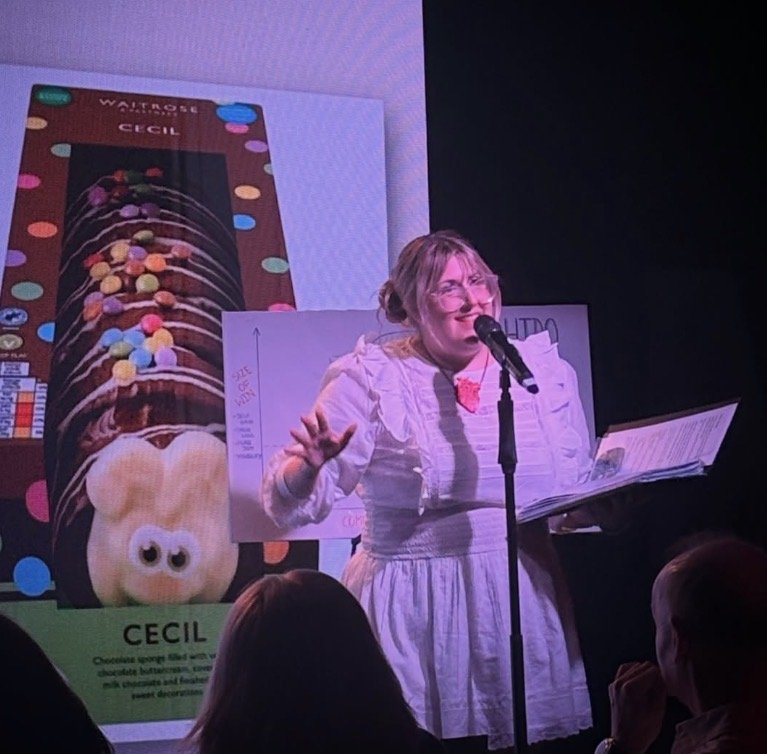
Smash hit Chief Petty Officer brings comedy lecture to Edinburgh Fringe 2026
Your Chief Petty Officer will say you now. Vix Leyton brings stand up comedy lecture to Edinburgh Fringe, asking how you define the perfect petty act.
A comedy lecture on grudges, fairness, history and humanity's refusal to let things go
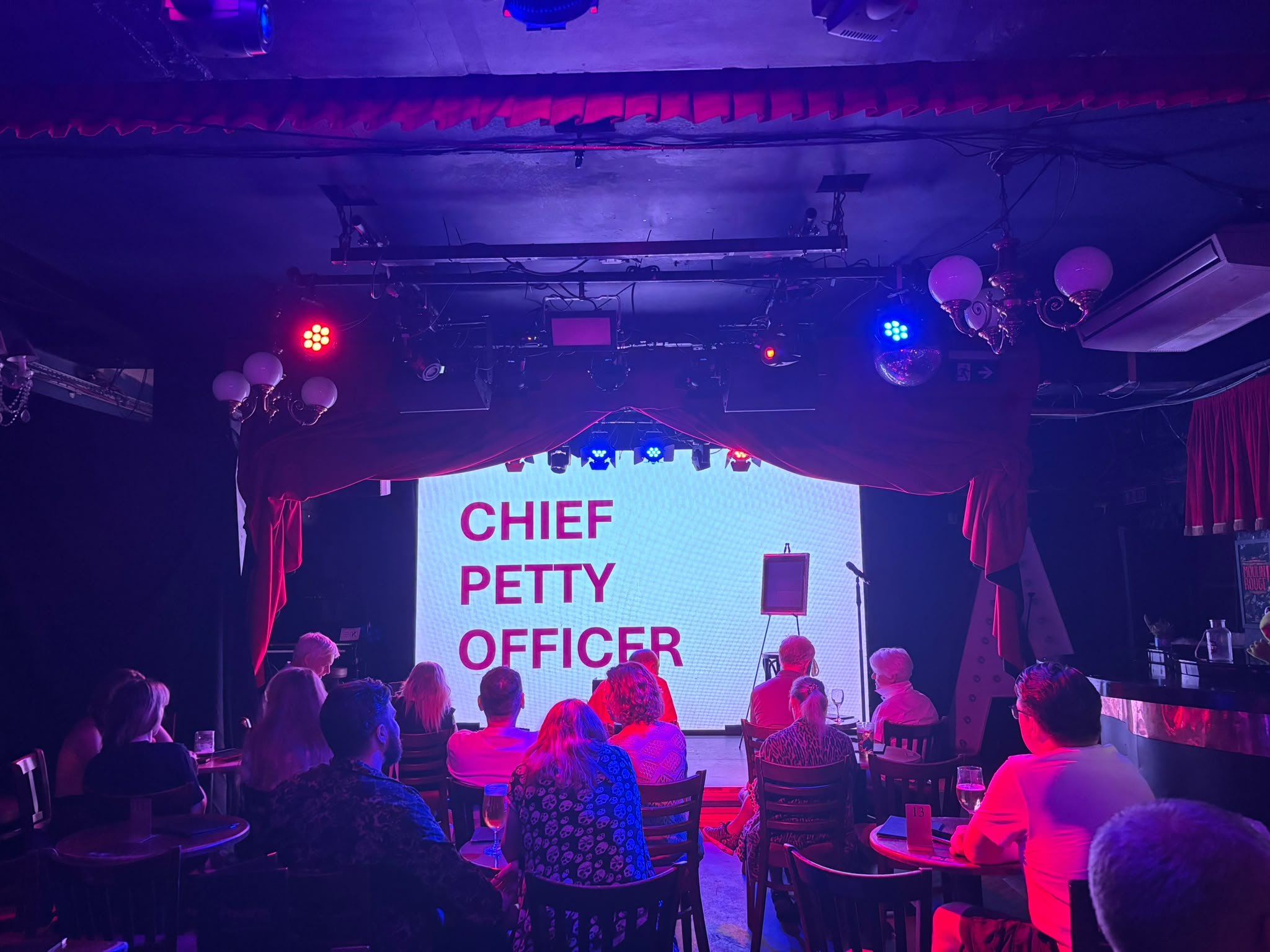
For years, Welsh comedian, broadcaster and consumer champion Vix Leyton has helped people fight back against unfairness.
Whether exposing consumer issues, helping audiences navigate disputes on BBC programmes including Morning Live, or investigating stories through her podcast work, much of her career has centred on a deceptively simple idea: what happens when people decide something isn't fair?
Her latest Edinburgh Fringe hour, Chief Petty Officer, asks what happens when that instinct goes much, much further. Already selling out at Brighton Fringe, Leicester and Sheffield, with a run that has seen over 400 people attend the previews.
Part stand-up show, part comedy lecture and part historical investigation, Chief Petty Officer explores the hidden role of pettiness in shaping history, politics, culture and everyday life. Through historical feuds, celebrity rivalries, corporate vendettas, internet drama and everyday British passive aggression, Leyton attempts to answer one question: What makes the perfect petty act?
Armed with research, stories and a whiteboard, she sets out to create a definitive formula for pettiness, examining how apparently minor slights can inspire extraordinary responses.
Along the way, the show uncovers a surprising truth: the line between principle and pettiness is often far thinner than we'd like to admit.
"As a consumer expert, I've spent years talking to people who are fighting for justice over things that seem small to everyone else," says Leyton. "A missing refund, an unfair charge, a pothole being ignored by the local council. What fascinated me while researching this show was realising that the same instinct appears throughout history.
"People have an incredible capacity to devote huge amounts of energy to correcting what they perceive as a minor wrong. Sometimes that results in a successful complaint. Sometimes it starts a war, creates a rival company, or changes the course of history."
Chief Petty Officer marks the first time Leyton has brought together her dual careers in broadcasting and comedy. A regular BBC contributor and co-host of the consumer podcast False Economy and Spendology, she has built a reputation for making complex subjects engaging and accessible. In comedy, she is also the creator and producer of the hit live show- pod The Comedy Arcade, which has enjoyed multiple successful runs at the Edinburgh Fringe and beyond.
Remarkably, Leyton only began performing stand-up a few years ago after taking a comedy course to overcome a fear of public speaking. Initially worried she had started too late, she quickly discovered a love of live performance and storytelling, leading to a growing comedy career.
"Looking back, this show feels inevitable," she says. "I've spent years professionally investigating what happens when people refuse to accept unfairness. Chief Petty Officer is what happened when I realised history is full of exactly the same people.
"The difference is that sometimes the response is a complaint letter, and sometimes it's founding a rival shoe company out of spite."
Blending sharp observation, historical storytelling and cultural commentary, Chief Petty Officer is a funny and unexpectedly revealing exploration of humanity's enduring need to balance the scales, no matter how small the injustice.
Or how petty the response.
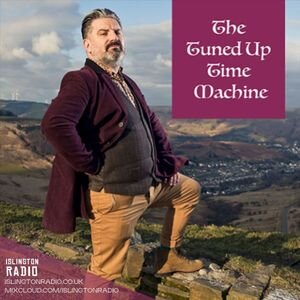
Tuned Up Time Machine on Islington Radio
Vix is now self-professed Head of Facts on Rich Wilson’s smash hit show Tuned Up Time Machine on Islington Radio, available on MixCloud.
Alongside stand up and podcast host of ‘Insane in the Men Brain’, Time Lord Rich Wilson, Producer Paul Daniels and Big Knobs, Vix acts as ‘Victionary Corner’ bringing all the behind the music facts. The show comes out every Wednesday and is described as an eclectic musical journey with songs from all eras.
You can listen here: Tuned Up Time Machine
Comedy Arcade is coming.
Comedy Arcade - a new podcast that is part friendly panel show, part savage competition where comedians compete to tell the best story around a topic randomly generated from an old fashioned arcade bingo ball.
Recording begins on 29th September at Spiritland Studios with stand up comedy titans including season regulars Esyllt Sears, Thom Tuck, and brilliant guests Esther Manito, Maureen Younger, John-Luke Roberts, Sara Barron, Leslie Ewing-Burgess, Sikisa, Tiernan Douieb and John Robertson.
Launching with Acast on 17th October.
Comedy Arcade Photos, styling and branding imagined by Studio 1440 with photographs by the brilliantly talented Jason Alden

Why I resigned from Slimming Clubs (for good)
NOTE: I originally wrote this for Standard Issue Magazine back in 2017 - SI still exists but it’s now an absolutely banging podcast that you should all subscribe to. With that business out of the way, and with the focus on ‘fighting obesity’ and rise of Slimming Club chat online, thought it was worth reposting it here.
When I went to a doctor about a possible thyroid problem last year that was hereditary in my family and a very likely diagnosis, the doctor point blank refused to test me and recommended I go to WeightWatchers. I had to go to a private doctor and pay for the test. The problem was nothing to do with my weight.
Me and food, relationship status: complicated.
I don’t know when it started, but I feel like I’ve always been aware of my weight, and it’s never quite matched what I wanted.
From pounding the step machine for an hour a day in the run-up to my school prom, through my difficult spell in uni involving subsisting on vodka and tins of sweetcorn to my, mercifully brief, dabbling with prescription slimming pills lifted from my mother’s cupboard (with ingredients from the amphetamine family – be still, my racing heart), I seem to have given a depressing amount of headspace to my size and my feelings about it.
The mood in my brain over the last two decades has swung wildly between Beyoncé affirmations of, ‘Girl, you own this!’ to the dark cocktail hour of the soul that is the cabbage soup diet. All with an underlying pathological fear of bread that I have never quite shifted since Dr Atkins ruined food for everyone back in the early noughties.
It all means I’m an expert on trying (and ultimately failing) to lose weight. I know the calorie count of most foods like I was born with the knowledge, and have been two to three stone both sides of where I currently am. One recurring theme in the endless conversations about diets that I seemed to be constantly subjecting myself to, was evangelism for ‘group slimming’, and I eventually bowed to the pressure.
Full disclosure: I’ve never put back on the first stone I lost the very first time I went to my ‘slimming by committee’ weapon of choice, so for the purposes of doing what it says on the tin, I suppose it stands up to scrutiny. Stick to the plan, you will lose weight. The rub is the psychological cost.
For me, what slimming clubs represent is very troubling because what they really sell is hope. It’s a plan that is almost too easy: you don’t have to give up the things you love, you can eat all the carbs you want! Five jacket potatoes for lunch? Crack on! And therein lies the rub: the plan requires no real introspection into your relationship with food and why you think losing weight might transform your life.
For someone like me, who spent years believing I was two stone away from living the life I dreamed of, it’s validation of that view. Come in! Sit in a circle and talk about everything you put in your mouth and we will make you thin – the holy grail for the image consciously insecure.
All you need to do is commit to following a plan that places a value on the things that make life taste nice, and follow it for the rest of your life, measuring each week not by the joy you had, but by how you controlled your food intake.
Coping strategies were developed in ‘group’ for things like family weddings, birthdays and holidays, turning them into obstacles to your end-game of ‘thin’ rather than exciting things you should be looking forward to. Helpful suggestions to make your life a socially awkward, shaming horror show included taking Fry Light on holiday and asking restaurants to use that instead of oil. The group also frequently involved tearful confessions from people who fell to the evils of the Big Mac, lambasting themselves for their moments of weakness.
But is it therapy? In the same way you wouldn’t take the advice of a shop assistant on commission on how good you look in something they want you to buy without a pinch of salt, just how much can you trust and rely on the slimming group ‘consultants’ telling you what you should and shouldn’t be eating?
By the time I’d gone back for the fifth and final time, having once again regained weight to my self-set hard limit, the whole thing had lost its gloss and got me thinking about what I was doing to myself.
Weight loss/diet groups are a huge industry. When you think about it, selling a plan meant to rehabilitate you and your eating habits and set you free to live your life is simply not in the business model.
What is lucrative is a critical mass of people like me who have tasted enough success to know it works, but left the groups light and smug with no better awareness of where the extra weight was coming from or why it went away. Like elastic bands, we keep coming back – rejoining, paying our £5 a week to be weighed and evaluated, repeat ad infinitum.
If you ask how the plan works, you get a vague answer: you don’t have to know how it works, it just does. And then when you leave, it just stops. I also found myself starting to vocally rail against what I perceived to be nutritionally dubious advice: shop-bought salads – even those that are full of the right, healthy stuff – are risky territory. Much safer to stick to Mug Shots or just-add-water couscous (to borrow from Mark Corrigan in Peep Show, “Misery sand”). Points/syns/whatever-wise, nuts and olives sit side-by-side with Mars bars, like all foods are created equal.
Even putting misery sand aside, ‘on plan’ I wasn’t eating healthily; not in what I ate particularly – I actually like vegetables and salads; my vices are mainly booze and cheese – but in terms of how I ate it. My week was in two halves; the three days before weigh-in, where I desperately went hard to correct for the other half, those halcyon three days post-weigh where I felt like I had a clean sheet and room to breathe.
All of this culminating in the dreaded weigh day itself. I got into the habit of eating nothing until after my evening weigh-in and stopping drinking at least three hours before; anything to put the scales gods on my side. If I stayed the same, gained, or lost less than I felt I deserved, the next couple of days were ruined.
It wasn’t any particular epiphany that had me quit after Christmas 2015. I genuinely thought I’d go back. It developed more slowly, like a Polaroid: the whole process was dominating my headspace even more than my weight consciousness did. It put the very trivial matter of what I weigh front and centre of all decision making.
What slimming clubs represent is very troubling because a lot of what they are really sell is hope. The plan requires no real introspection into your relationship with food and why you think losing weight might transform your life.
For that stone possibly lost forever (who knows? Who cares, at this point) I have paid a very high price over six years. I’ve sat grumpily at the hen parties of beloved friends, refusing to touch cocktails and sticking to ‘gin and slim’, worried about upcoming holidays and how sad I would be to undo all my good work, dreading events where there might be a buffet.
I’ve eaten at some of the best restaurants in London (on expenses as a PR) and had salad, with the dressing on the side – and I can tell you with conviction that a salad is a salad wherever you go. I have been either ‘on plan’, or ‘off plan’. And off plan tended to involve at least a few weeks in a euphoric orgy of eating all that I couldn’t before.
It was like playing a very long game of snakes and ladders, and the disappointment of sliding back to square one was harder every time. I harbour the suspicion that for every amazing success story – and I know there are many, these guys’ PR machines are excellent – there are 100 people like me in a cycle of successes and failure arbitrarily measured by the capricious numbers on the scales. The process is reductive in more than the way that you pay for.
If this piece of writing in itself isn’t quite enough to get me blacklisted forever then let this serve as my official resignation from slimming by committee.
There is absolutely no criticism intended of the people who have done it or will continue to do it. I know why – and anyone taking any proactive steps to tackle the reasons for their unhappiness has nothing but respect from me.
But I needed to look at why my self-worth was so intrinsically linked to a machine that I could influence by moving around the bathroom floor, rather than simply have the opinion that it was so readily validated by people who have a vested interest in doing so.
Slimming clubs, it’s not you, it’s me. It just took me a while to get here.
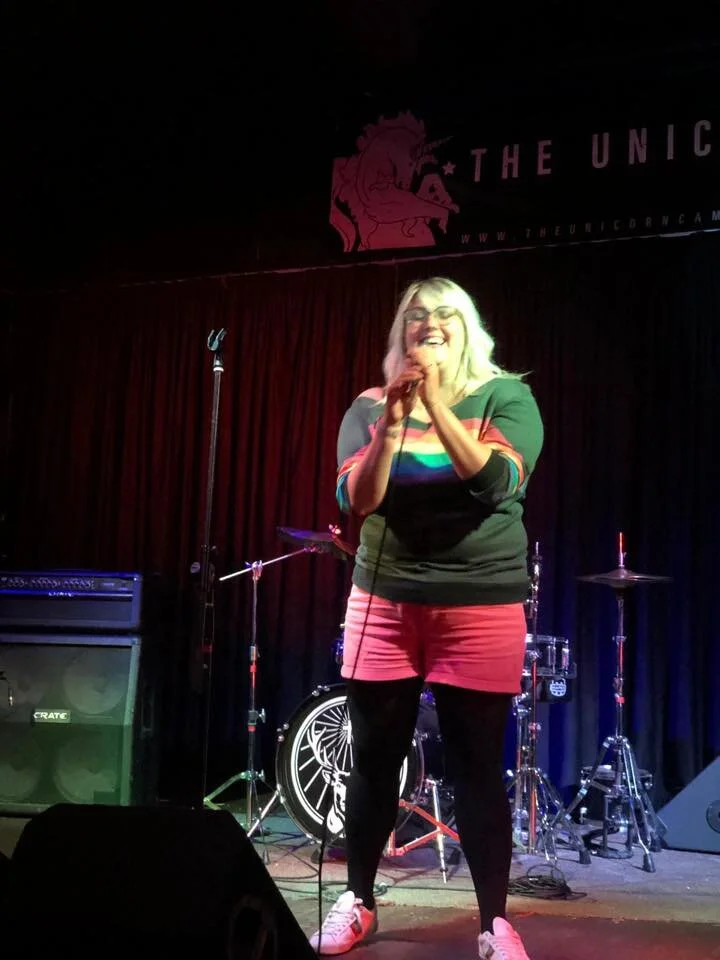
Vix makes it through to the heats for Funny Women Awards 2020
Vix’s videos made the cut as one of the 50ish acts longlisted from 325 entries to go to the next round of the Funny Women Awards.
Normally this would mean going into the LIVE REGIONAL heats but for reasons we won’t talk about, those little videos that were sent of with a kiss and a prayer now compete against a handful of the other acts head to head for a panel of judges. Huge honour to make the cut, particularly alongside some of her circuit favourites.
Good luck to the other entrants … specifically the ones not in Vix’s heat #SorryNotSorry
You can follow her progress at www.funnywomen.com
Comedy Roulette is coming
A new streamed comedy concept is coming - are you ready?
Okay, so I couldn’t resist the lure of trying to put my own virtual gig together.
With that in mind...
Been thinking long and hard about how it could work and it’s not going to run as traditional sets, it’s going to be part show and part game. Borrowing heavily from Mock The Week, your host (me - Vix) will hold a numbered list of 30 possible subjects - from everyday to current affairs - which comics will be given a few days in advance so they can think about any jokes or stories that might fit.
Which subjects come up on the night will be left to fate… and fate will operate via a bingo machine. The subjects will be determined by whatever numbers come up in the balls, and comics with a relevant bit of material can jump in.
The jokes can be anything from one liners to songs and stories, with the best joke of the night winning £25. The key is to keep it moving so no one feels like they’re a tiny person chatting under a belljar into the void. We’re going to have fun.
Comics, if you want to be part of it then email neonflamingocomedy@gmail.com and tell me a little bit about yourself.
Prospective audience… you just need to wait for further instruction.
See you soon,
Vix xxx
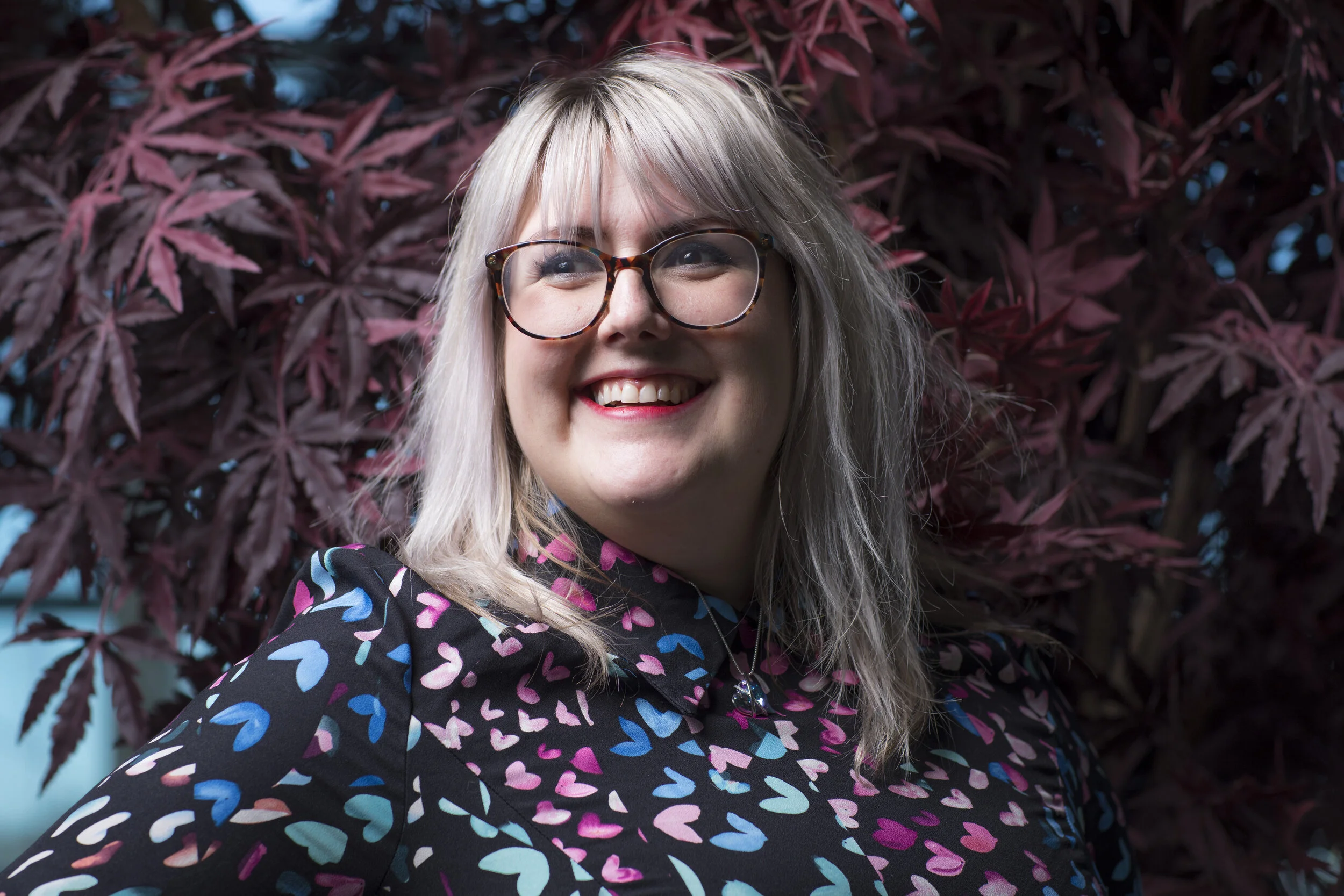
Comedy, comparison, and Mental Health Awareness Week
TW: Weight loss
Mental Health Awareness Week felt like a time to share something that has been rattling about in my head and in various drafts for a while. Stand up comedy has been quietly transformative to me and my mental health, that progress is very slow but it’s still progress.
Comparison, as they say, is the thief of joy. And as a relatively new woman comedian on the open mic circuit last year, comparison was absolutely rife. I have just tentatively started making baby steps on the circuit compared to my sisters in arms, but nonetheless I have already established a recurring theme amongst those giving feedback; prior to us all going into Lockdown, several strangers have sought me out at the end of shows just to tell me how much I remind them of Rebel Wilson.
Every time it unleashed a whole torrent of conflicting thoughts, hurt, because - despite best efforts to rail against it - societal pressure has conditioned me to equate comparison to someone else fat as shorthand for being unattractive - I am inner-wired to default to fatphobia thanks to a lifetime of diet chat, magazines, and even my friends and family inadvertently canonising and celebrating a thinner frame, and then guilt for feeling offence and hurt, as I think Rebel Wilson is glorious, as a performer and as a beautiful woman. It is clearly always meant as a compliment and it is flattering to be compared to someone so successful but she isn’t known for stand up. Rebel Wilson is an actress who plays strident, bold take-it-or-leave-it characters on screen. Her roles have often centred around her size, something I very carefully navigate away from in my material, and she is very physical whereas I rarely take my hand off the mic stand, like it’s the only crutch keeping me standing. I've been all around the houses trying to rationalise it, and I've come to the only conclusion I can really come to - the similarities are primarily that I'm blonde, around the same age, and overweight, suggesting the comparison is a shorthand unwittingly based on looks, rather than style.
There is a phrase bandied around and in hundreds of memes that thin doesn’t make you happy, a riff on Kate Moss’s ‘nothing tastes as good as skinny feels’. I find both statements complicated as there are some unfortunate personal truths to both in my lived experience, despite knowing that Moss's view is deeply flawed, and she has clearly never had the cornbread from Caravan. Being slimmer did not hand me the life of my dreams but, as someone with some very faulty mental wiring that made any mirror into a funhouse where what I saw depended on how much I loathed myself that day, dieting and feeling lighter quieted the beehive that I keep somewhere in my head that was telling me I was not good enough. Dangerously, it was positively endorsed by everyone around me telling me I looked amazing and gorgeous and well, when I was actually miserable, swooning from hunger, not enjoying anything I ate because I boiled it all down to syns or celebrated self restraint. It was treating the symptom (badly) not the cure, but it was addictive in itself.
I have historically had a very unhealthy relationship with food that seems to push me to exist wildly swerving between two states, feast and famine. When I have been in a process of one of my slimming phases and things I have ‘outgrown’ - my wardrobe spans 5 sizes - suddenly fit, I do feel temporarily better and more at peace. And in terms of Kate’s depressing truth, even in full feasting mode, the spectre of the consequences of enjoying indulgent food is usually on my shoulder whispering in my ear, cutting through even the noisiest crowd on the happiest occasion. This disordered way of thinking has led me to some pretty stupid choices in the past, from the weeks in my first year at University where I ritualistically ate only a tin of sweetcorn and a half of a Supermarket egg fried rice every day to a thankfully brief spell of taking amphetamine based slimming pills acquired by somewhat nefarious means.
In the last couple of years I kept the bees at bay through less extreme means by regular trips to the gym, the physical act of going seeming to buy me some mental space without resorting to unhealthy measures as feeling fit has made me feel strong and powerful and more at home in my body, but I've more or less made my peace that this is something chronic that I have no choice but to build mechanisms of varying success to live alongside. Social media has kickstarted a movement to love yourself that has no doubt been transformative for a lot of people; more representation of people living and enjoying a life that typically has been coded to belong to a specific type of body is a Very Good Thing. I passionately see nothing but beauty in those fierce, amazing and gorgeous women who are strident in their body confidence but I don’t know if I can ever apply this same rational, objectivity to myself. Loving myself and owning my weight won't make people less likely to make a judgement on me, won't erase years of knowing that you're likely being measured up in most new rooms you walk into, and that size has connotations. The world is not kind to fat people and while it's getting better, the dial is not moving quick enough to erase years of learned-behaviour, for both fat people who expect and are braced to be judged, and those who judge those who are fat without even thinking about it - these prejudices often run too deep to be spirited away.
Lockdown has been a stressful proposition for me, with my disordered behaviour patterns. I’m aware I’m not as active as I typically would be, by a long shot, and I’m haunted by the spectre of putting on ‘too much’ weight - whatever too much is - but also being ashamed of my own fatphobia. At the same time, anxiety has eaten away at me, and I’ve inadvertently lost mass in a short , unsustainable space of time - not something to be celebrated, I’m very troubled about how much I like it. I’m rummaging through the cupboard looking for the things that now fit (again) - and the niggling voice in the back of my mind that reminds me it might be easier if I tried not to put it back on adds to the pressure that was already building up over my lack of activity. It’s tiring, and the realisation that this mental fuckery that has haunted me for years can still drag on me like Japanese knotweed makes me miserable. There is every reason in the world to be worried about everything BUT THIS, it’s toxic, meaningless and unproductive ... and I’m still giving it preferential headspace, and feeling guilty in all kinds of ways for doing it.
I would love to be one more example for other bigger women who are living freely despite being outsize of societal acceptable bodies, but the battle to accept myself on any given day can be so draining that I don't have the energy to be the change I want to see. I still, at low points, wish I could wake up one morning and find that I'm a size 10, because life would likely be much easier, it shouldn't be, but it would.
Doing comedy has forced me to make my peace with a lot of things - when you are on stage, you're fully exposed from the top of your head to your feet, there is no clever angle to hide behind. Braced, for years, to reject all photos and videos of myself that aren't to a very specific self-taken brief, I've relaxed a tiny bit because I can see the happiness and energy I feel when I am on stage making people laugh and that is beautiful. I'm even sharing photos I hate, because I'm so proud of what they represent in terms of how far I've come in finding something I love that much. This comforts me that maybe I'm not a lost cause. I don't think I'll ever feel truly 100% positive in myself, I’m not really wired that way. But feeling more neutral? That is something I could give a shot.
It’s live, Jim, but not as we know it.
Just 13% of people expect to be ready to go out and experience live entertainment in the next 1-2 Months, with over half (51%) thinking it will be over 5 months and a cautious 16% going as far as saying it will be a year. The will to risk it decreases exponentially with age, with over 65s the most pessimistic about when they’ll be ready to return, in contrast to the 46% of under 25s expecting to be ready in 1 - 2 months.
Stand up comedy in lockdown; where do we go from here?
Why the comedy industry needs to seriously think about streaming
It’s been eight weeks since I did my last proper stage gig. It was a milestone night because it was my 100th show and also marked a whole year of doing comedy. The room was absolutely packed as I picked through to take to the stage at the amazing, bonkers Alternative Comedy Memorial Society on 10th March, jostling with hosts Thom Tuck and John Luke Roberts. Jokes were made that this might be the last audience we’d see for a while, but made in the same breath as how much everyone was looking forward to Fringe, as no virus could possibly derail that monolith.
We all know what happened next.
Melbourne Comedy Festival being cancelled days before it was due to kick off signalled the start of a complete collapse in live entertainment, initially because people were scared to go and eventually because they weren’t allowed. As beloved, established institutions like Angel Comedy plead for help to keep going, the big question is just how long will it take for things to get back to normal… will they ever?
To try to understand the scale of it, I commissioned a national survey of 2000 people via Censuswide last week and the findings were stark. Just 13% of people expect to be ready to go out and experience live entertainment in the next 1-2 Months, with over half (51%) thinking it will be over 5 months and a cautious 16% going as far as saying it will be a year. The will to risk it decreases exponentially with age, with over 65s the most pessimistic about when they’ll be ready to return, in contrast to the 46% of under 25s expecting to be ready in 1 - 2 months.
In terms of the environment would-be audiences would want in order to feel comfortable post covid-19, there is a lot to think about in terms of potentially adapting venues and a lot of our beloved, intimate spaces will no doubt struggle to accommodate this from a logistics and financial point of view. The data showed over a third, 34%, would like to see social distancing in venues, 16% will be staying local for the immediate future and 19% will avoid small venues altogether.
But the skirmish to create in captivity has sparked one potential positive when it comes to future-proofing the industry for a more modern audience.
It has undoubtedly pushed stage performers to look at what they can offer online, leading to a wealth of new, interesting, entertainment concepts appearing and the genesis of fully online comedy shows - from pro nights in established venues like The Stand, to open mics, with the best experiences and solutions being workshopped and identified rapidly by absolute necessity. Not only does this keep comics in touch with their established fans it also opens the door to thousands of new ones - London, typically an epicentre for everything from new talents to legends, can be accessible to a global audience, with mobility no object, via the magic of technology. And it’s not just a more diverse audience, it also opens the book on more diversity and variety on the bill, with travel not necessary. You only had to look at the tour de force of global talent at Mark Watson’s recent ‘Watsonathon’ involving over 100 acts dialling in from every corner of the world, to an audience of thousands to appreciate the potential of this in the right hands. And with more eyes, comes the opportunity for more income, providing a showcase for shows already on sale, podcasts, audiobooks and subscription only content using tools like Patreon.
19% of people say they are enjoying experiencing the extra streamed content they are getting from their favourite artists at the moment, rising to 24% of under 25s, with generations coming up much more comfortable with seeing their entertainment via a small screen, and engaging with it in a more interactive way.
That said, there is a lot of work to do in educating people on the value of the entertainment they are seeing, as 25% expect all streamed content to be free of charge. With online audiences conditioned for ‘free’ high quality content (heavily subsidised behind closed doors through affiliate deals and brand partnerships), the move to a paid model is likely to be a bumpy one. As we’ve seen in the last few weeks, some of the biggest profit making successes in streamed comedy have come from charity ventures, where viewers understand clearly why they are parting with their cash in a way you would never have to justify for a play or a concert.
One thing that was heartening to see was that the younger you are, the more prepared you are to pay for someone’s work; according to the stats, the digital native under- 35s are the most likely to be happy to stump up versus the average (20% versus 11%) although that number is still woefully low. Similarly, whilst people might still be nervous about venturing out, there is a will to support their favourite artists; whether or not they’re planning to go, 15% say they will buy tickets for their favourite performer as soon as they can to support them, rising to 22% of those under 35.
A keen 15% want to see more streamed content from their favourite artists, again higher in under 35s where it rises to 20%. Less good news, 11% say they are not interested at all as they prefer the live experience, although time will tell if this is a position that will change, with Netflix ‘completed’ and long summer evenings potentially stretching out without plans.
For those doing it well, there is a unique intimacy to the experience you won’t necessarily get at the average comedy show, and it is proving really popular with those who love the art of comedy. Always Be Comedy are amongst those offering the opportunity to be in the digital ‘front row’ and an active part of the show, or you can easily just skulk around off camera with no risk of ever being picked on - a primary reason for some avoiding stand up altogether. You can also chance an open mic without the fear of becoming a hostage to a bad night; don’t like it? Shut your laptop. Want another drink? Whack up the volume and listen while you head to the fridge.
And for anyone worrying about how their experimental content is being received, the good news is overall there is no issue on quality, just 8% think the output of entertainers in lockdown feels amateur.
There is a lot to do, and the industry we left is undoubtedly not going to be the one we’re going back to, meaning the only option is to go forward. As a marketer in my day job, the one potential thing I can see that can be taken away in what has undoubtedly been an unprecedented devastation of an industry I love, is that there is huge opportunity in online for reaching new people and finding new ways to make things work financially while we wait and hope for the live scene to rise again. There is no substitute for a live experience, but that doesn’t mean other methods can’t hold value and there is potential to open up the comedy world to those who wouldn’t normally have access it.
Survey conducted of 2000 nationally representative respondents by Censuswide 4th May - and commissioned for Vix Leyton